Behavioral Responses of Nonsmokers to Environmental Tobacco Smoke Exposure
DOI:
https://doi.org/10.12928/si.v24i1.580Keywords:
Actual exposure outcome, Adolescent passive smokers, PLS-SEM, Second-hand smoke, TPBAbstract
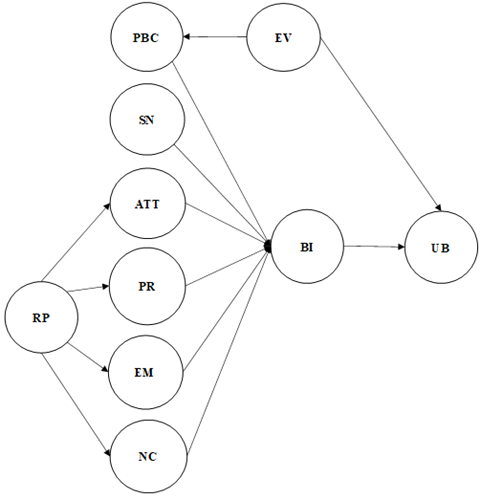
Second-hand smoke (SHS) exposure remains a significant public health issue among Indonesian adolescents, particularly in areas where smoking is socially accepted and smoke-free regulations are weakly enforced. However, limited research explains the psychosocial mechanisms shaping protective intentions among adolescent passive smokers in non-metropolitan settings. This study examines the determinants of protective behavioral intention and actual SHS exposure by extending the Theory of Planned Behavior (TPB) with additional cognitive, emotional, and environmental constructs. By incorporating risk perception, emotional responses, psychological reactions, negative cognition, and environmental exposure, the study offers a context-sensitive behavioral framework for SHS in high-exposure environments. Data were collected through a survey of 140 adolescent non-smokers in Tanjung Selor, Indonesia, who were routinely exposed to cigarette smoke. The model was analyzed using Partial Least Squares Structural Equation Modeling (PLS-SEM). The results show that emotional responses (Beta = 0.399, p < 0.001) and environmental exposure (Beta = 0.401, p < 0.001) significantly predict protective behavioral intention, whereas the classical TPB constructs show limited explanatory power. Risk perception exerts strong indirect effects through emotional responses (Beta = 0.678, p < 0.001) rather than directly influencing intention. Behavioral intention strongly predicts actual SHS exposure (Beta = 0.507, p < 0.001). These findings indicate that adolescents’ protective intentions are shaped more by affective and environmental factors than by rational evaluations alone. This study contributes to provide study extends TPB in SHS research and provides empirical guidance for emotion-driven and environment-focused tobacco control interventions in non-metropolitan regions.
References
Ajzen, I. (1991). The Theory of Planned Behavior. Organizational Behavior and Human Decision Processes, 50, 179–211. https://doi.org/10.1016/0749-5978(91)90020-T
Ayu, P., Astuti, S., Assunta, M., & Freeman, B. (2020). Why is tobacco control progress in Indonesia stalled? -a qualitative analysis of interviews with tobacco control experts. BMC Public Health, 20(527), 1-12. https://doi.org/10.1186/s12889-020-08640-6
Brewer, N. T., Defrank, J. T., & Gilkey, M. B. (2016). Anticipated Regret and Health Behavior: A Meta-Analysis. American Psychological Association. https://doi.org/10.1037/hea0000294
Byron, M. J., Cohen, J. E., Frattaroli, S., Gittelsohn, J., Drope, J. M., & Jernigan, D. H. (2019). Implementing smoke-free policies in low- and middle- income countries: A brief review and research agenda. Tobacco Induced Diseases, 17(60), 1–10. https://doi.org/10.18332/tid/110007
Chen, P., Li, Y., Wu, D., Liu, F., Cao, C., Chen, P., Li, Y., Wu, D., Liu, F., & Cao, C. (2023). Secondhand Smoke Exposure and the Risk of Chronic Obstructive Pulmonary Disease: A Systematic Review and Meta-Analysis. International Journal of Chronic obstructive pulmonary disease. 9106. https://doi.org/10.2147/COPD.S403158
Conner, M., & Norman, P. (2022). Understanding the intention-behavior gap: The role of intention strength. Frontiers in Psychology, 13(August), 1–16. https://doi.org/10.3389/fpsyg.2022.923464
Dillard, A. J., Ferrer, R. A., Ubel, P. A., & Fagerlin, A. (2012). Risk Perception Measures Associations With Behavior Intentions , Affect , and Cognition Following Colon Cancer Screening Messages. Health Psychology, 31(1), 106–113. https://doi.org/10.1037/a0024787
East, K. A., Hitchman, S. C., Mcdermott, M., Mcneill, A., Herbe, A., & Tountas, Y. (2019). Social norms towards smoking and electronic cigarettes among adult smokers in seven European Countries: Findings from the EUREST-PLUS ITC Europe Surveys. Tobacco Induced Diseases. February, 1–12. https://doi.org/10.18332/tid/104417
Hair, J. F., Risher, J. J., & Ringle, C. M. (2018). When to use and how to report the results of PLS-SEM. European Business Review. 31(1), 2–24. https://doi.org/10.1108/EBR-11-2018-0203
Henseler. (2017). Partial Least Squares Path Modeling. Advanced Methods for Modeling Markets, 361–381. https://doi.org/10.1007/978-3-319-53469-5
Hitchman, S. C., Fong, G. T., Zanna, M. P., Hyland, A., & Bansal-travers, M. (2010). Support and correlates of support for banning smoking in cars with children: findings from the ITC Four Country Survey. European Journal of Public Health, 21(3), 360–365. https://doi.org/10.1093/eurpub/ckq097
Irawati, D. Y., Widari, N. S., & Canariesa, A. R. (2025). Why Riders Break the Rules: A Structural Equation Modeling Approach to Traffic Violations in a Developing Region. In Spektrum Industri. https://doi.org/10.12928/si.v23i2.393
Jakubowska, D., Dabrowska, A. Z., Pacholek, B., & Sady, S. (2024). Behavioral intention to purchase sustainable food: Generation Z's perspective. In Sustainability. https://doi.org/10.3390/su16177284
Jr, J. J. C., Brady, M. K., & Hult, G. T. M. (2000). Assessing the effects of quality, value, and customer satisfaction on consumer behavioral intentions in service environments. Journal of Retailing. https://doi.org/10.1016/S0022-4359(00)00028-2
Kusuma, D., Kusumawardani, N., Ahsan, A., Sebayang, S. K., Amir, V., & Ng, N. (2019). On the verge of a chronic disease epidemic: comprehensive policies and actions are needed in Indonesia. International Health, 11(July), 422–424. https://doi.org/10.1093/inthealth/ihz025
Li, L., Long, X., Laubayeva, A., Cai, X., & Zhu, B. (2020). Behavioral intention of environmentally friendly agricultural food: the role of policy, perceived value, subjective norm. Environmental Science and Pollution Research. https://doi.org/10.1007/s11356-020-08261-x
Linden, S. Van Der. (2021). The Gateway Belief Model (GBM): A review and research agenda for communicating the scientific consensus on climate change. Current Opinion in Psychology, 42, 7–12. https://doi.org/10.1016/j.copsyc.2021.01.005
Loewenstein, G.F., Weber, E.U., Hsee, C.K., Welch, N. (2001). Risk as Feelings. Psychological Bulletin, 127(2), 267–286. https://psycnet.apa.org/doi/10.1037/0033-2909.127.2.267
Maier, S. F. (1976). Learned Helplessness: Theory and Evidence. Journal of Experimental Psychology: General, 105(1), 3–46. https://psycnet.apa.org/doi/10.1037/0096-3445.105.1.3
Margarini, E. (2023). Just HCD-in Teens to Stop Smoking. Ministry of Health of the Republic of Indonesia.
Mulyati, E., Maniah, M., Noviana, N., & Pardede, N. (2025). Performance Analysis of the IndoBERT–Prophet Hybrid Model for Logistics Applications. In Spektrum Industri. https://doi.org/10.12928/si.v23i2.480
Nurmansyah, M.I., Umniyatun, Y., Jannah, M. Syiroj, A.T., Hidayar, D. N. (2019). Knowledge , attitude and practice of cigarette smoking among senior secondary school students in Depok , Indonesia Abstract: International Journal Of AdolescentMedicine And Health, 1–9. https://doi.org/10.1515/ijamh-2018-0124
Orbell, S., & Verplanken, B. (2018). Progress and Prospects in Habit Research. The Psychology of Habit, 397–409. https://doi.org/10.1007/978-3-319-97529-0
Orsal, O., & Ergun, A. (2021). The Effect of Peer Education on Decision-Making, Addiction, and Behavior Change in the Process of Quitting Smoking of Young People The Effect of Peer Education on Decision-Making, Smoking-Promoting Factors , Self-Efficacy, Addiction, and Behavior Cha. Risk Management and Healthcare Policy ISSN, 14(925–945). https://doi.org/10.2147/RMHP.S280393
Ortiz, A. B., & Larco, R. M. C. (2021). Second - hand smoking, hypertension and cardiovascular risk: findings from Peru. BMC Cardiovascular Disorders, 1–8. https://doi.org/10.1186/s12872-021-02410-x
eters, E., Shoots-reinhard, B., Evans, A. T., Shoben, A., Klein, E. G., Mary, M. P. H., Tompkins, K., Romer, M. A. D., & Tusler, M. (2019). Pictorial Warning Labels and Memory for Cigarette Health-risk Information Over Time. Annals of Behavioral Medicine, 53, 358–371. https://doi.org/10.1093/abm/kay050
Ping, P., Sheng, Y., Qin, W., Miyajima, C., & Takeda, K. (2018). Modeling Driver Risk Perception on City Roads Using Deep Learning. IEEE Access, 6, 68850–68866. https://doi.org/10.1109/ACCESS.2018.2879887
Pisinger, V. S. C., Holst, C. A., Bendtsen, P., Becker, U., & Tolstrup, J. S. (2017). Perceived parental alcohol problems and drinking patterns in youth: A cross-sectional study of 69 , 030 secondary education students in Denmark. Preventive Medicine, 105, 389–396. https://doi.org/10.1016/j.ypmed.2017.01.003
Putra, I.W., Astuti, P.A., Duana, I.M., Suarjana, I.K., Mulyawan, K.H., Kurniasari, N. M. (2023). The Implementation of Smoke - Free Workplace Policy and the Determinants Affecting Indoor Smoking in Indonesia. WHO South-East Asia J Public Health, 11, 97–101. https://doi.org/10.4103/WHO-SEAJPH.WHO-SEAJPH
Rhodes, R. E., Boudreau, P., & Josefsson, K. W. (2021). Mediators of physical activity behaviour change interventions among adults: a systematic review and meta-analysis. Health Psychology Review, 15(2). https://doi.org/10.1080/17437199.2019.1706614
Safa, F., Chaiton, M., Mahmud, I., Ahmed, S., & Chu, A. (2020). The association between exposure to second-hand smoke and sleep disturbances: A systematic review and meta-analysis. Sleep Health: Journal of the National Sleep Foundation, 6(5), 702–714. https://doi.org/10.1016/j.sleh.2020.03.008
Seemiller, C., & Grace, M. (2018). Generation Z: A Century in the Making (Routledge (ed.); 1st Editio). https://doi-org.ezproxy.ugm.ac.id/10.4324/9780429442476
Septiono, W., Kuipers, M. A. G., Ng, N., & Kunst, A. E. (2020). Changes in adolescent smoking with implementation of local smoke-free policies in Indonesia: Quasi-experimental repeat cross-sectional analysis of national surveys of 2007 and 2013. Drug and Alcohol Dependence, 209(March), 107954. https://doi.org/10.1016/j.drugalcdep.2020.107954
Sheeran, P. (2021). Intention - Behavior Relations: A Conceptual and Empirical Review Intention-Behaviour Relations: A Conceptual and Empirical Review. European Review of Social Psychology, 12(1–36). https://doi.org/10.1002/0470013478.ch1
Slovic, P., Finucane, M. L., Peters, E., & Macgregor, D. G. (2007). The affect heuristic. European Journal of Operational Research. 177, 1333–1352. https://doi.org/10.1016/j.ejor.2005.04.006
Steinberg, L. (2014). Age of Opportunity: Lessons from the New Science of Adolescence. Houghton Mifflin Harcourt.
Tehrani, H., Mahdizadeh, M., Peyman, N., Gholian-Aval, M., Charoghchian Khorasani, E., & Jafari, A. (2022). Exploration factors on smoking among female adolescents based on the viewpoints of Iranian adolescent girls. BMC Women’s Health, 22(1), 1–8. https://doi.org/10.1186/s12905-022-01791-1
Vambheim, S. M., & Flaten, M. A. (2017). A systematic review of sex differences in the placebo and the nocebo effect. Journal of Pain Research, 10, 1831–1839. https://doi.org/10.2147/JPR.S134745
WHO, I. (2024). Ministry of Health and WHO release Global Adult Tobacco Survey Indonesia Report 2021. WHO.
Downloads
Published
Issue
Section
License
Copyright (c) 2026 Desrina Yusi Irawati, Nyoman Sri Widari, Armadeo Ruben Canariesa

This work is licensed under a Creative Commons Attribution-ShareAlike 4.0 International License.





.png)