The Effects of Intermittent Noise and Whole-Body Vibration on Cognitive Performance
DOI:
https://doi.org/10.12928/si.v24i1.520Keywords:
Cognitive performance, Intermittent noise, Selective attention, Stroop task, Whole-body vibrationAbstract
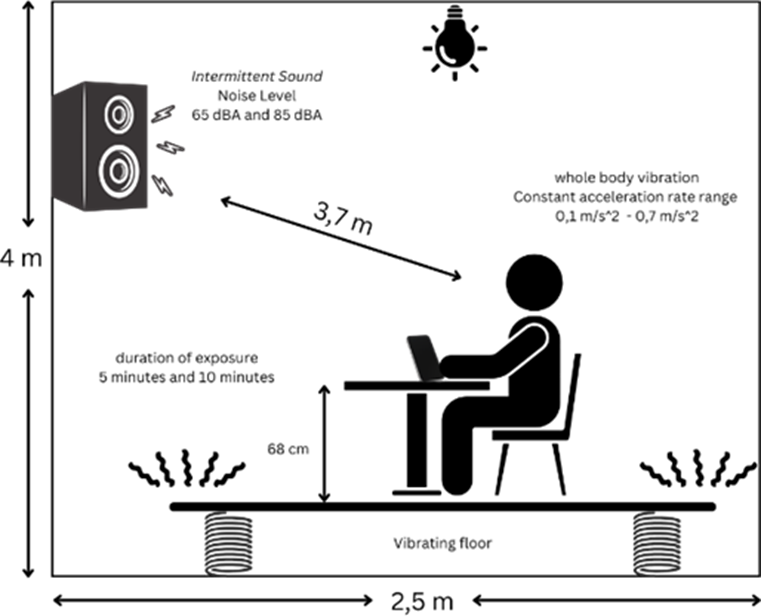
Work environments involving noise and whole-body vibration are known to affect human cognitive performance, particularly selective attention. The aim of this study is to identify and analyse the impact of noise level and whole-body vibration exposure duration on cognitive performance using a controlled laboratory experiment and the Stroop Task. Cognitive performance was measured by total response time and accuracy under two intermittent noise levels (65 dBA and 85 dBA) and two whole-body vibration exposure durations (5 minutes and 10 minutes). Multivariate analysis indicated that intermittent noise significantly reduced response accuracy, while longer whole-body vibration exposure slowed response time. No significant interaction between noise and vibration was observed, suggesting that each factor affects cognition through different mechanisms. This study presents novel empirical evidence on the combined cognitive effects of intermittent noise and whole-body vibration exposure assessed via the Stroop Task, an approach rarely used in prior research. This study contributes to provide a better understanding of how physical environmental stressors influence selective attention in occupational settings. From a scientific perspective, controlling noise intensity and the duration of whole-body vibration exposure are essential to minimise adverse cognitive effects at work. Future research should investigate the long-term and combined effects of exposure under more complex cognitive task conditions.
References
Asbee, J., Kelly, K., McMahan, T., & Parsons, T. D. (2022). Factor Analysis of the Virtual Reality Stroop Task. Journal of Clinical and Experimental Neuropsychology, 44(8), 604–617. https://doi.org/10.1080/13803395.2022.2150749
Bufano, P., Di Tecco, C., Fattori, A., Barnini, T., Comotti, A., Ciocan, C., Ferrari, L., Mastorci, F., Laurino, M., & Bonzini, M. (2024). The Effects of Work on Cognitive functions: A systematic review. Frontiers in Psychology, 15, 1–25. https://doi.org/10.3389/fpsyg.2024.1351625
Butorina, M., Kuklin, D., & Drozdova, L. (2021). Application of Soundproof Planning to Reduce Noise in Residential Building. IOP Conference Series: Earth and Environmental Science, 666(4), 042006. https://doi.org/10.1088/1755-1315/666/4/042006
Carter, N. L., & Beh, H. C. (1989). The Effect of Intermittent Noise on Cardiovascular Functioning During Vigilance Task Performance. Psychophysiology, 26(5), 548–559. https://doi.org/10.1111/j.1469-8986.1989.tb00708.x
Ghasemi, A., & Zahediasl, S. (2012). Normality Tests for Statistical Analysis: A Guide for Non-Statisticians. International Journal of Endocrinology and Metabolism, 10(2), 486–489. https://doi.org/10.5812/ijem.3505
Grenzebach, J., & Romanus, E. (2022). Quantifying the Effect of Noise on Cognitive Processes. Noise and Health, 24(115), 199–214. https://doi.org/10.4103/nah.nah_34_22
Jafari, M. J., Khosrowabadi, R., Khodakarim, S., & Mohammadian, F. (2019). The Effect of Noise Exposure on Cognitive Performance and Brain Activity Patterns. Open Access Macedonian Journal of Medical Sciences, 7(17), 2924–2931. https://doi.org/10.3889/oamjms.2019.742
Jafari, Z., Kolb, B. E., & Mohajerani, M. H. (2019). Noise Exposure Accelerates the Risk of Cognitive Impairment and Alzheimer’s Disease: Adulthood, Gestational, and Prenatal Mechanistic Evidence from Animal Studies. Neuroscience & Biobehavioral Reviews, 1–19. https://doi.org/10.1016/j.neubiorev.2019.04.001
Jahncke, H., & Hallman, D. M. (2020). Objective Measures of Cognitive Performance in Activity Based Workplaces and Traditional Office Types. Journal of Environmental Psychology, 72, 1–10. https://doi.org/10.1016/j.jenvp.2020.101503
Jazani, R. K., Saremi, M., Kavousi, A., Monazam, M. R., & Abedi, M. (2012). The Effect of Whole-Body Vibration on Vehicle Driver’s Reaction Time and Mental and Physiological Workload. Annals of Military and Health Sciences Research, 10(4), 278–284. https://brieflands.com/journals/amhsr/articles/67643
Kelley, K. (2010). Sample Size Planning. In I. B. Weiner & W. E. Craighead (Eds.), The Corsini Encyclopedia of Psychology. Wiley. https://doi.org/10.1002/9780470479216.corpsy0812
Knudsen, E. I. (2018). Neural Circuits That Mediate Selective Attention: A Comparative Perspective. Trends in Neurosciences, 41(11), 789–805. https://doi.org/10.1016/j.tins.2018.06.006
Lakens, D. (2022). Sample Size Justification. Collabra: Psychology, 8(1), 1–28. https://doi.org/10.1525/collabra.33267
Ljungberg, J., Neely, G., & Lundström, R. (2004). Cognitive Performance and Subjective Experience During Combined Exposures to Whole-Body Vibration and Noise. International Archives of Occupational and Environmental Health, 77(3), 217–221. https://doi.org/10.1007/s00420-003-0497-7
Marcotte, P., Beaugrand, S., Boutin, J., & Larue, C. (2010). Design and Evaluation of a Suspension Seat to Reduce Vibration Exposure of Subway Operators: A Case Study. Industrial Health, 48(5), 715–724. https://doi.org/10.2486/indhealth.MSWBVI-17
Marelli, S., Ferrario, C., Lorenzini, G., Ravi, Y. S., Mazzoleni, A., & Tarabini, M. (2023). Effects of the Whole-Body Vibration Direction on the Cognitive Response of Standing Subjects. Ergonomics, 66(9), 1270–1279. https://doi.org/10.1080/00140139.2022.2144647
Asbee, J., Kelly, K., McMahan, T., & Parsons, T. D. (2022). Factor Analysis of the Virtual Reality Stroop Task. Journal of Clinical and Experimental Neuropsychology, 44(8), 604–617. https://doi.org/10.1080/13803395.2022.2150749
Bufano, P., Di Tecco, C., Fattori, A., Barnini, T., Comotti, A., Ciocan, C., Ferrari, L., Mastorci, F., Laurino, M., & Bonzini, M. (2024). The Effects of Work on Cognitive functions: A systematic review. Frontiers in Psychology, 15, 1–25. https://doi.org/10.3389/fpsyg.2024.1351625
Butorina, M., Kuklin, D., & Drozdova, L. (2021). Application of Soundproof Planning to Reduce Noise in Residential Building. IOP Conference Series: Earth and Environmental Science, 666(4), 042006. https://doi.org/10.1088/1755-1315/666/4/042006
Carter, N. L., & Beh, H. C. (1989). The Effect of Intermittent Noise on Cardiovascular Functioning During Vigilance Task Performance. Psychophysiology, 26(5), 548–559. https://doi.org/10.1111/j.1469-8986.1989.tb00708.x
Ghasemi, A., & Zahediasl, S. (2012). Normality Tests for Statistical Analysis: A Guide for Non-Statisticians. International Journal of Endocrinology and Metabolism, 10(2), 486–489. https://doi.org/10.5812/ijem.3505
Grenzebach, J., & Romanus, E. (2022). Quantifying the Effect of Noise on Cognitive Processes. Noise and Health, 24(115), 199–214. https://doi.org/10.4103/nah.nah_34_22
Jafari, M. J., Khosrowabadi, R., Khodakarim, S., & Mohammadian, F. (2019). The Effect of Noise Exposure on Cognitive Performance and Brain Activity Patterns. Open Access Macedonian Journal of Medical Sciences, 7(17), 2924–2931. https://doi.org/10.3889/oamjms.2019.742
Jafari, Z., Kolb, B. E., & Mohajerani, M. H. (2019). Noise Exposure Accelerates the Risk of Cognitive Impairment and Alzheimer’s Disease: Adulthood, Gestational, and Prenatal Mechanistic Evidence from Animal Studies. Neuroscience & Biobehavioral Reviews, 1–19. https://doi.org/10.1016/j.neubiorev.2019.04.001
Jahncke, H., & Hallman, D. M. (2020). Objective Measures of Cognitive Performance in Activity Based Workplaces and Traditional Office Types. Journal of Environmental Psychology, 72, 1–10. https://doi.org/10.1016/j.jenvp.2020.101503
Jazani, R. K., Saremi, M., Kavousi, A., Monazam, M. R., & Abedi, M. (2012). The Effect of Whole-Body Vibration on Vehicle Driver’s Reaction Time and Mental and Physiological Workload. Annals of Military and Health Sciences Research, 10(4), 278–284. https://brieflands.com/journals/amhsr/articles/67643
Kelley, K. (2010). Sample Size Planning. In I. B. Weiner & W. E. Craighead (Eds.), The Corsini Encyclopedia of Psychology. Wiley. https://doi.org/10.1002/9780470479216.corpsy0812
Knudsen, E. I. (2018). Neural Circuits That Mediate Selective Attention: A Comparative Perspective. Trends in Neurosciences, 41(11), 789–805. https://doi.org/10.1016/j.tins.2018.06.006
Lakens, D. (2022). Sample Size Justification. Collabra: Psychology, 8(1), 1–28. https://doi.org/10.1525/collabra.33267
Ljungberg, J., Neely, G., & Lundström, R. (2004). Cognitive Performance and Subjective Experience During Combined Exposures to Whole-Body Vibration and Noise. International Archives of Occupational and Environmental Health, 77(3), 217–221. https://doi.org/10.1007/s00420-003-0497-7
Marcotte, P., Beaugrand, S., Boutin, J., & Larue, C. (2010). Design and Evaluation of a Suspension Seat to Reduce Vibration Exposure of Subway Operators: A Case Study. Industrial Health, 48(5), 715–724. https://doi.org/10.2486/indhealth.MSWBVI-17
Marelli, S., Ferrario, C., Lorenzini, G., Ravi, Y. S., Mazzoleni, A., & Tarabini, M. (2023). Effects of the Whole-Body Vibration Direction on the Cognitive Response of Standing Subjects. Ergonomics, 66(9), 1270–1279. https://doi.org/10.1080/00140139.2022.2144647
Mesa, C., P., L. H., Knöfel, B., Troge, J., Drossel, W.-G., Klein, M., & Hübelt, J. (2021). Exposure to Industrial Noise: Impacts on Cognitive Performance. INTER-NOISE and NOISE-CON Congress and Conference Proceedings, 263(4), 2590–2600. https://doi.org/10.3397/IN-2021-2180
Mohammadian, F., Nasiri, Parvin, Giahi, Omid, Rezvani, Z., Kangavari, Mehdi, & Rafieepour, Athena. (2015). Effects of Noise and Whole Body Vibration on Individual’s Mental Performance. International Journal of Occupational Hygiene, 7(4), 209–214. http://ijoh.tums.ac.ir
Morihara, T., Yokoshima, S., & Matsumoto, Y. (2020). Experimental Study on Combined Effect of Shinkansen Railway Noise and Vibration on daily activities: A case of reading and calculation tasks. Acoustical Science and Technology, 41(3), 607–613. https://doi.org/10.1250/ast.41.607
Nadri, H., Khavanin, A., Kim, I.-J., Akbari, M., & Gholami-Fesharaki, M. (2022). An Investigative Study on Cognitive Decline Among Textile Industry Workers with Occupational Noise-Induced Hearing Loss. Auditory and Vestibular Research, 31(3), 165–174. https://doi.org/10.18502/avr.v31i3.9866
Needs, D., Blotter, J., Cowan, M., Fellingham, G., Johnson, A. W., & Feland, J. B. (2023). Effect of Localized Vibration Massage on Popliteal Blood Flow. Journal of Clinical Medicine, 12(5), 1–10. https://doi.org/10.3390/jcm12052047
Pretzsch, A., Seidler, A., & Hegewald, J. (2021). Health Effects of Occupational Noise. Current Pollution Reports, 7(3), 344–358. https://doi.org/10.1007/s40726-021-00194-4
Rahmani, H., & Razmkhah, M. (2019). Homogeneity Test Based on Ranked Set Samples. Communications in Statistics - Theory and Methods, 4771–4786. https://doi.org/10.1080/03610926.2019.1609034
Rahmani, R., Aliabadi, M., Golmohammadi, R., Babamiri, M., & Farhadian, M. (2021). Evaluation of Cognitive Performance of City Bus Drivers with Respect to Noise and Vibration Exposure. Acoustics Australia, 49(3), 529–539. https://doi.org/10.1007/s40857-021-00248-z
Schlittmeier, S., Feil, A., Liebl, A., & Hellbrück, J. (2015). The Impact of Road Traffic Noise on Cognitive Performance in Attention-Based Tasks Depends on Noise Level Even Within Moderate-level Ranges. Noise and Health, 17(76), 148–157. https://doi.org/10.4103/1463-1741.155845
Seok, J.-W., Kim, J. U., & Kim, J.-D. (2025). Effects of Whole-Body Vibration on Cognitive Function: A Systematic Review and Meta-Analysis. GeroScience. https://doi.org/10.1007/s11357-025-01914-0
Smolker, H. R., Wang, K., Luciana, M., Bjork, J. M., Gonzalez, R., Barch, D. M., McGlade, E. C., Kaiser, R. H., Friedman, N. P., Hewitt, J. K., & Banich, M. T. (2022). The Emotional Word-Emotional Face Stroop Task in the ABCD Study: Psychometric Validation and Associations With Measures of Cognition and Psychopathology. Developmental Cognitive Neuroscience, 53, 1–10. https://doi.org/10.1016/j.dcn.2021.101054
Waldstein, S. R. (2003). The Relation of Hypertension to Cognitive Function. Current Directions in Psychological Science, 12(1), 9–13. https://doi.org/10.1111/1467-8721.01212
Yang, H., Gao, J., Wang, H.-Y., Ma, X.-M., Liu, B.-Y., Song, Q.-Z., Cheng, H., Li, S., Long, Z.-Y., Lu, X.-M., & Wang, Y.-T. (2025). The Effects and Possible Mechanisms of Whole-Body Vibration on Cognitive Function: A Narrative Review. Brain Research, 1850, 1–10. https://doi.org/10.1016/j.brainres.2024.149392
Zeng, A., Huang, Y., Xin, J., Li, J., Qiu, W., & Zhang, M. (2024). Progress and Recommendations of Developing Occupational Exposure Limits for Noise - A Systematic Review. Heliyon, 10, 1–19. https://doi.org/10.1016/j.heliyon.2024.e37878
Zhang, J., Pang, L., Yang, C., Fan, Y., Zhao, B., & Cao, X. (2024). Experimental Evaluation of Noise Exposure Effects on Subjective Perceptions and Cognitive Performance. Buildings, 14(1100), 1–23. https://doi.org/10.3390/buildings14041100
Downloads
Published
Issue
Section
License
Copyright (c) 2026 Rahmaniyah Dwi Astuti, Farreleo Adryanna Brilliansyah , Ade Aisyah Arifna Putri

This work is licensed under a Creative Commons Attribution-ShareAlike 4.0 International License.





.png)