Optimization of 2200 WP Solar Power Components for EV Charging Using SMART Method
DOI:
https://doi.org/10.12928/si.v24i1.613Keywords:
DSS, Electric vehicles, Off-grid solar PV, SMART method, Solar panelsAbstract
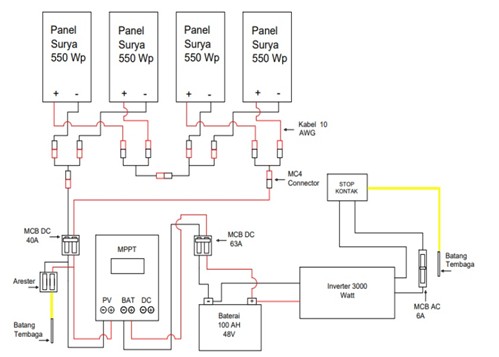
The performance, efficiency, and lifetime of off-grid photovoltaic (PV) systems are strongly influenced by the appropriate selection of key components, including solar panels, charge controllers, batteries, and inverters. This study aims to determine the optimal configuration of a 2200 Wp off-grid PV system for an electric vehicle charging station at Bandung Polytechnic of Manufacturing (Polman Bandung). A Decision Support System based on the Simple Multi-Attribute Rating Technique (SMART) was employed to evaluate multiple technical and functional criteria across several component alternatives. A total of 8 alternatives, consisting of 2 alternatives for each component, were quantitatively assessed using weighted criteria and preference scores to obtain a final ranking. The results indicate that the optimal configuration consists of monocrystalline solar panels, an MPPT charge controller, LiFePO4 batteries, and a pure sine wave inverter, achieving the highest overall utility value. The system produced an output of approximately 1300 W, corresponding to about 59% of the installed capacity (2200 Wp), which reflects the system performance ratio under real operating conditions rather than the intrinsic efficiency of the PV modules. This study contributes to the selection of appropriate components that significantly improve the efficiency, reliability, and operational performance of the system. In conclusion, the SMART-based DSS effectively identifies the optimal components for a 2200 Wp off-grid solar power system, providing a practical and robust solution for electric vehicle charging under varying environmental conditions while ensuring improved efficiency, reliability, and system lifetime.
References
Assareh, E., Izadyar, N., Jamei, E., Monzavian, M. amin, Agarwal, S., & Agarwal, N. (2025). Optimizing solar-powered multi-generation systems for sustainable energy management in university buildings using Neural Networks and Genetic Algorithms. Journal of Building Engineering, 108, 112939. https://doi.org/10.1016/j.jobe.2025.112939
Barnett-Itzhaki, Z., Tifferet, S., Berkowic, D., Arviv, T., Daya, A., Carasso Romano, G. H., & Levi, A. (2025). Strategies and challenges for green campuses. Frontiers in Sustainable Cities, 7. https://doi.org/10.3389/frsc.2025.1469274
Bhatia, M., & Williams, A. (2023). Selection of Criteria Using MCDM Techniques: An Application in Renewable Energy. ArXiv Preprint ArXiv:2303.17520. https://arxiv.org/abs/2303.17520
Dalle, J., Aydin, H., & Wang, C. X. (2024). Cultural dimensions of technology acceptance and adaptation in learning environments. Journal of Formative Design in Learning. https://doi.org/10.1007/s41686-024-00095-x
Dzialek, J., Jarecka-Bidzinska, E., Staniewska, A., & Teoule, F. (2025). (Re)greening transition of academic green spaces as a response to social and environmental challenges: The role of bottom-up initiatives. Urban Forestry & Urban Greening, 105, 128692. https://doi.org/10.1016/j.ufug.2025.128692
Edwards, W. (1977). How to use multiattribute utility measurement for social decisionmaking. IEEE Transactions on Systems, Man, and Cybernetic. https://doi.org/10.1109/TSMC.1977.4309720
Fachrudin, H. T., & Fachrudin, K. A. (2021). The relationship between green behaviour and green campus principles: A literature review. IOP Conference Series: Materials Science and Engineering, 1122(1), 012028. https://doi.org/10.1088/1757-899X/1122/1/012028
Gunawan, H., Basyuni, M., Subarudi, & Suharti, S. (2025). Empowering conservation: the transformative role of mangrove education in Indonesia’s climate strategies. Forest Science and Technology. https://doi.org/10.1080/21580103.2025.2519475
Herth, A., Verburg, R., & Blok, K. (2025). How can campus living labs thrive to reach sustainable solutions? Cleaner Production Letters, 8, 100078. https://doi.org/10.1016/j.clpl.2024.100078
Herzanita, A., Lestari, R. T., & Dewi, A. P. (2024). Assessing Green Building Implementation and Barriers in Campus Settings. International Journal of Environmental Impacts, 7c(3), 593–601. https://doi.org/10.18280/ijei.070320
Hindayanti, H., Septiani, W., & Maulidya, R. (2024). Employee performance assessment model in survey service companies using analytical hierarchy process and Naive Bayes. In Spektrum Industri. https://doi.org/10.12928/si.v22i1.150
Kulaksiz, A. A., & Akkaya, R. (2012). A genetic algorithm optimized ANN-based MPPT algorithm for a stand-alone PV system with induction motor drive. Solar Energy. https://doi.org/10.1016/j.solener.2012.05.006
Kumar, T., Kumar, M., Kumar, A., Kumar, R., & Bag, M. (2025). A review of current progress in perovskite-based energy storage to photorechargeable systems. Energy & Fuels. https://doi.org/10.1021/acs.energyfuels.4c05865
Leon-Becerra, J., Sanchez, J. M., & Adarme, A. M. (2023). Patient Experience Management as a Tool for Internationalization in Foundation Cardiovascular of Colombia. In Spektrum Industri. https://doi.org/10.12928/si.v21i2.163
Madani, S. S., Shabeer, Y., Allard, F., Fowler, M., Ziebert, C., & Khalilpour, K. (2025). A comprehensive review on lithium-ion battery lifetime prediction and aging mechanism analysis. In Batteries. https://doi.org/10.3390/batteries11040127
Maka, A. O. M., & Chaudhary, T. N. (2024). Performance investigation of solar photovoltaic systems integrated with battery energy storage. Journal of Energy Storage. https://doi.org/10.1016/j.est.2024.110784
Nurfaidah, Y., Wibawa, I. P. D., Aprilia, B. N. D., & Ekaputri, C. (2019). Analysis of smart house power savings with on-grid photovoltaic power system. Journal of Physics Conference Series. https://doi.org/10.1088/1742-6596/1367/1/012047
Oktavianti, E., Komala, N., & Nugrahani, F. (2019). Simple multi attribute rating technique (SMART) method on employee promotions. Journal of Physics: Conference Series, 1193, 012028. https://doi.org/10.1088/1742-6596/1193/1/012028
Parvaneh, F., & Hammad, A. (2024). Application of Multi-Criteria Decision-Making (MCDM) to Select the Most Sustainable Power-Generating Technology. Sustainability, 16(8), 3287. https://doi.org/10.3390/su16083287
Pereira, R., J. M., Hoeckesfeld, L., Dal Magro, C. B., Favretto, J., Barichello, R., Lenzi, F. C., Secchi, L., Montenegro de Lima, C. R., & Salgueirinho Osório de Andrade Guerra, J. B. (2021). Green Campus Initiatives as sustainable development dissemination at higher education institutions: Students’ perceptions. Journal of Cleaner Production, 312, 127671. https://doi.org/10.1016/j.jclepro.2021.127671
Pohekar, S. D., & Ramachandran, M. (2004). Application of multi-criteria decision making to sustainable energy planning-A review. Renewable and Sustainable Energy Reviews, 8(4), 365–381. https://doi.org/10.1016/j.rser.2003.12.007
Praveen, P. N., & Menaka, D. (2024). A dual-axis solar tracking system with minimized tracking error through optimization technique. Multimedia Tools and Applications. https://doi.org/10.1007/s11042-023-17698-4
Purnama, D. A., Rana, Z. A. M., Lumi, D. P., Haritza, I. T., & Haritza, I. T. (2025). Modeling Public Transportation Policy Using Macroscopic Social Media Data Mining. In Spektrum Industri. https://doi.org/10.12928/si.v23i2.327
Putri, E. P., Parinov, I. A., & Wongloucha, C. (2024). Efficiency Evaluation in Indonesia’s Quarrying Industry Using Variable Combinations DEA. In Spektrum Industri. https://doi.org/10.12928/si.v22i2.227
Ria, A., & Dini, P. (2024). A compact overview on Li-ion batteries characteristics and battery management systems integration for automotive applications. In Energies. https://doi.org/10.3390/en17235992
Risawandi, R. R., & Rahim, R. (2016). Study of the simple multi-attribute rating technique for decision support. In International Journal of Scientific Research in Science and Technology. https://ijsrst.com/IJSRST162696
Romadin, A., Yoto, Y., & Nurhadi, D. (2021). Multicase study of technician careers in manufacturing industry. In Spektrum Industri. https://doi.org/10.12928/si.v19i2.20952
Sahoo, S. K., & Goswami, S. S. (2023). A Comprehensive Review of Multiple Criteria Decision-Making (MCDM) Methods: Advancements, Applications, and Future Directions. Decision Making Advances, 1(1), 25–48. https://doi.org/10.31181/dma1120237
Saikia, P., Das, N., & Buragohain, M. (2024). Robust energy storage system for stable in wind and solar. Renewable and Sustainable Energy Reviews. https://doi.org/10.1016/j.rser.2023.114079
Schwertner, S., Buchberger, T., Diehl, S., Ferg, R., Hanzl, C., & Endisch, C. (2025). Design and Implementation of an Intelligent Reconfigurable High-Voltage Battery System for Next-Generation Electric Vehicles. In Batteries. https://doi.org/10.3390/batteries11110424
Seng, T., & Sasso, P. (2023). An Exploration of Using Solar Photovoltaic Cells as a Sustainable Solution in Higher Education. Higher Education Politics &Economics. https://doi.org/10.32674/hepe.v9i2.5869
Streimikiene, D., Balezentis, T., Krisciukaitiene, I., & Balezentis, A. (2012). Prioritizing sustainable electricity production technologies: MCDM approach. Renewable and Sustainable Energy Reviews, 16(5), 3302–3311. https://doi.org/10.1016/j.rser.2012.02.067
Taherdoost, H., & Mohebi, A. (2024). Using SMART Method for Multi-criteria Decision Making: Applications, Advantages, and Limitations. Archives of Advanced Engineering Science, 2(4), 190–197. https://doi.org/10.47852/bonviewAAES42022765
Valiris, G., Chytas, P., & Glykas, M. (2005). Making decisions using the balanced scorecard and the simple multi-attribute rating technique. Performance Measurement and Metrics, 6(3), 159–171. https://doi.org/10.1108/14678040510636720
Viera ,T., L., Leal Filho, W., Avila Pedrozo, E., Machado do Nascimento, L. F., Vieira, K., Hernandez-Diaz, P. M., Pimenta Dinis, M. A., & Lange Salvia, A. (2025). Towards smart approaches to sustainability on campuses: construction, validation and assessment of a measurement scale. International Journal of Sustainability in Higher Education. https://doi.org/10.1108/IJSHE-10-2024-0744
Wang, J.-J., Jing, Y.-Y., Zhang, C.-F., & Zhao, J.-H. (2009). Review on multi-criteria decision analysis aid in sustainable energy decision-making. Renewable and Sustainable Energy Reviews, 13(9), 2263–2278. https://doi.org/10.1016/j.rser.2009.06.021
Yang, Z., & Xiao, Z. (2023). A review of the sustainable development of solar photovoltaic tracking system technology. In Energies. https://doi.org/10.3390/en16237768
Downloads
Published
Issue
Section
License
Copyright (c) 2026 ganis sanhaji, Rani nopriyanti

This work is licensed under a Creative Commons Attribution-ShareAlike 4.0 International License.







.png)