Towards an Integrated Framework of Sustainable Business Strategy Formulation in the Textile Industry: A PRISMA-Based Systematic Literature Review
DOI:
https://doi.org/10.12928/si.v24i2.619Keywords:
Multi-criteria decision making, Strategy formulation, Sustainable business strategy, Systematic Literature Review, Textile industryAbstract
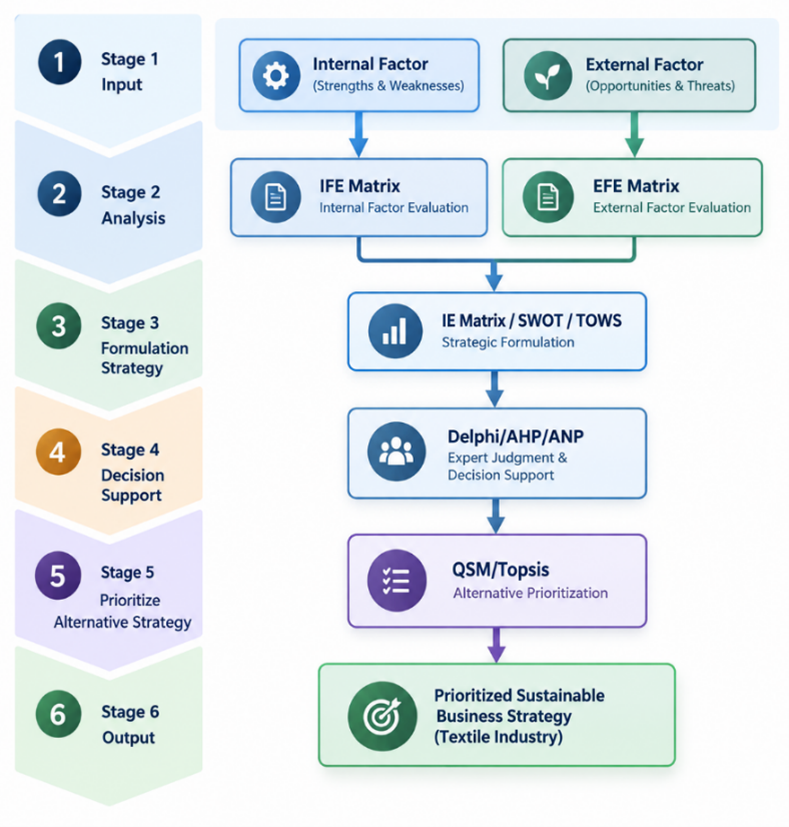
The textile industry faces increasing pressure to adopt sustainability strategies in response to environmental, economic, and social challenges. However, sustainability strategy formulation in this sector remains fragmented, particularly in analytical and decision-making approaches. This study aims to systematically review and synthesize methods for sustainable business strategy formulation in the textile industry and to identify integration pathway toward a more coherent approach. A systematic literature review (SLR) using the Preferred Reporting Items for Systematic and Meta Analysis (PRISMA) methods selected 30 relevant journal articles from an initial pool of 646 publications. The findings reveal that while these methods are frequently applied, their integrated relationship follows a distinct sequential logic: the Internal–External (IE) matrix maps the organizational strategic position, SWOT analysis generates feasible strategic alternatives, Multi-Criteria Decision-Making (MCDM) approaches assign transparent weights to multidimensional sustainability criteria, and the Quantitative Strategic Planning Matrix (QSPM) objectively ranks and prioritizes those alternatives. Nevertheless, prior studies in the textile sector rarely integrate SWOT, Internal Factor Evaluation (IFE), External Factor Evaluation (EFE), and QSPM within a unified sustainability-oriented framework. Therefore, the novelty of this study lies in synthesizing these fragmented methods into a cohesive conceptual framework tailored specifically to support sustainable business strategy formulation in the textile industry. This study provides an integrated conceptual explanation that connects internal–external analysis with sustainability-oriented strategic prioritization, addressing methodological fragmentation in prior research. However, it should be noted that this proposed framework remains conceptual and has not yet been empirically validated in real-world textile industry settings.
References
Abbate, S., Centobelli, P., Cerchione, R., Nadeem, S. P., & Riccio, E. (2023). Sustainability trends and gaps in the textile, apparel and fashion industries. Environment, Development and Sustainability, 26(2), 2837–2864. https://doi.org/10.1007/s10668-022-02887-2
Adolph, J., & Beckmann, M. (2024). Corporate sustainability strategy: From definitional ambiguity toward conceptual clarification. Business Strategy and the Environment, 33(5), 4708–4729. https://doi.org/10.1002/bse.3722
Alam, A., Nashiruddin, A., Bafana, F. A., Bashir, M. S., & Alimusa, L. O. (2024). mplementing Waqf Forests in Indonesia: A SWOT and Internal-External Factor Evaluation Analysis. International Journal of Environmental Impacts, 7(3), 475–483. https://doi.org/10.18280/ijei.070309
Alda, T., Shalihin, A., Revadi, C. E., Nasution, F. R. P., Andifa, R. A., Tarigan, N. S. F. B., Irsan, M., Pandapotan, A., Halim, J. M., & Ningsih, R. W. (2025). Design of a Strategy for the Sustainable Development of the Bakery Industry in Medan City. The 8th Mechanical Engineering, Science and Technology International Conference, 10. https://doi.org/10.3390/engproc2025084010
Angkuraseranee, T., Wattanachan, C., & Boonthep, K. (2025). Assessing market potential and SWOT-based strategies for Betong chicken in Pattani, Yala, and Narathiwat provinces of southern Thailand. The Thai Journal of Veterinary Medicine, 55(3), 1–8. https://doi.org/10.56808/2985-1130.3884
Arraya, I. G. R. T., & Triono, S. P. H. (2025). Business strategy formulation using IE and SWOT matrix: Case study of medical device company. Multidisciplinary Science Journal, 8(3), 2026008. https://doi.org/10.31893/multiscience.2026008
Bandrova, T., Dinkov, D., & Vasilev, S. (2025). Strategy for the Development of Cartography in Bulgaria with a 10-Year Planning Horizon (2025–2035) in the Context of Industry 4.0 and 5.0. ISPRS International Journal of Geo-Information, 14(8), 289. https://doi.org/10.3390/ijgi14080289
Barbosa, M., Castaneda, Ayarza, J. A., & Lombardo Ferreira, D. H. (2020). Sustainable Strategic Management (GES): Sustainability in small business. Journal of Cleaner Production, 258, 120880. https://doi.org/10.1016/j.jclepro.2020.120880
Barbosa, P. I., Szklo, A., & Gurgel, A. (2022). Sugarcane ethanol companies in Brazil: Growth challenges and strategy perspectives using Delphi and SWOT-AHP methods. Biomass and Bioenergy, 158, 106368. https://doi.org/10.1016/j.biombioe.2022.106368
Barletta, M., D'Adamo, I., Garza-Reyes, J. A., & Gastaldi, M. (2024). Business strategy and innovative models in the fashion industry: Clothing leasing as a driver of sustainability. Business Strategy and the Environment, 33(5), 4730–4743. https://doi.org/10.1002/bse.3723
Budihardjo, M. A., Humaira, N. G., Ramadan, B. S., Wahyuningrum, I. F. S., & Huboyo, H. S. (2023). Strategies to reduce greenhouse gas emissions from municipal solid waste management in Indonesia: The case of Semarang City. Alexandria Engineering Journal, 69, 771–783. https://doi.org/10.1016/j.aej.2023.02.029
Dafia, C. S. N., Chen, F., & Sumo, P. D. (2022). Guideline and Strategies of Textile Industry on the Sustainable Development of Benin. Sustainability, 14(19), 12762. https://doi.org/10.3390/su141912762
Dim, C. C., Mbachu, C. O., Enebe, N. O., Kassy, W. C., Nnagbo, J. E., Obi, I. E., Onodugo, N. P., Lasebikan, N. N., & Onodugo, O. D. (2025). Strategic SWOT analysis of the University of Nigeria Teaching Hospital using Modified Delphi Technique: implications for strengthening national and regional health systems. BMC Health Services Research, 25(1), 35. https://doi.org/10.1186/s12913-024-12076-8
Elsman, E. B. M., Mokkink, L. B., Terwee, C. B., Beaton, D., Gagnier, J. J., Tricco, A. C., Baba, A., Butcher, N. J., Smith, M., Hofstetter, C., Lee Aiyegbusi, O., Berardi, A., Farmer, J., Haywood, K. L., Krause, K. R., Markham, S., Mayo-Wilson, E., Mehdipour, A., Ricketts, J., & Offringa, M. (2024). Guideline for reporting systematic reviews of outcome measurement instruments (OMIs): PRISMA-COSMIN for OMIs 2024. Journal of Clinical Epidemiology, 173, 111422. https://doi.org/10.1016/j.jclinepi.2024.111422
Elvis, N. T., Cheng, H., & Providence, B. I. (2023). Exploring the Optimistic Approaches and Directives of Cameroon’s Textile Sector for Reliable Development. Sustainability, 15(7), 5896. https://doi.org/10.3390/su15075896
Encino-Munoz, A. G., & Yilan, G. (2025). Second-hand clothing and sustainability in the fashion sector: Analysing visions on circular strategies through SWOT/ANP method. Journal of Cleaner Production, 493, 144909. https://doi.org/10.1016/j.jclepro.2025.144909
Fares, N., & Lloret, J. (2022). An integrated SWOT-AHP-fuzzy TOPSIS approach for maturity management following the COVID-19 outbreak: lessons learned from fast fashion. Journal of Global Operations and Strategic Sourcing, 15(4), 510–533. https://doi.org/10.1108/JGOSS-09-2021-0072
Farrukh, A., & Sajjad, A. (2024). Drivers for and barriers to circular economy transition in the textile industry: A developing economy perspective. Sustainable Development, 32(6), 7309–7329. https://doi.org/10.1002/sd.3088
irdaus, F., Setyono, P., Gravitiani, E., & Liquiddanu, E. (2025). Key Drivers and Barriers to Circular Economy Practices in the Global Textile and Fashion Industries: Sustainable Strategies for the Indonesian Batik Industry. International Journal of Sustainable Development and Planning, 20(1), 327–346. https://doi.org/10.18280/ijsdp.200130
Gupta, V., Anand, S., Wei, D., Wang, G., & Tripathi, S. C. (2024). Exploring applied sustainable strategies through geoheritage and geotourism: A systematic literature review. International Journal of Geoheritage and Parks, 12(4), 660–677. https://doi.org/10.1016/j.ijgeop.2024.11.009
Herrera-Franco, G., Fornes, J. M., Bravo-Montero, Lady, Montalván, F. J., & Carrión-Mero, P. (2025). Water governance PESTEL/SWOT-TOWS analysis in the Andean Community of Nations (ACN). Environmental Challenges, 20, 101249. https://doi.org/10.1016/j.envc.2025.101249
Insani, A. A., & Haryono, E. (2025). Geodiversity hotspot and SWOT-TOWS-AHP assessment for regional geoconservation strategies in Kulon Progo Regency, Aspiring Jogja Geopark, Indonesia. International Journal of Geoheritage and Parks, 13(1), 144–165. https://doi.org/10.1016/j.ijgeop.2025.02.002
Jeelani, P., & Shah, S. A. (2024). Strategic insights for sustainable tourism development in Kashmir Valley: SWOT and QSPM analysis. Environmental Development, 52, 101092. https://doi.org/10.1016/j.envdev.2024.101092
Khosravani, F., Abbasi, E., Choobchian, S., & Jalili Ghazizade, M. (2025). Optimizing food waste management in Tehran: A SWOT analysis and strategic recommendations. Heliyon, 11(4), e42474. https://doi.org/10.1016/j.heliyon.2025.e42474
Kir, A., Ozturk, E., Yetis, U., & Kitis, M. (2024). Resource utilization in the sub-sectors of the textile industry: opportunities for sustainability. Environmental Science and Pollution Research, 31(17), 25312–25328. https://doi.org/10.1007/s11356-024-32768-2
Laktuka, K., Kubule, A., Vamza, I., Rozakis, S., & Blumberga, D. (2024). Strategic pathways for a bioeconomy with high value-added products: Lessons learnt from the Latvian forest sector. Biomass and Bioenergy, 190, 107400. https://doi.org/10.1016/j.biombioe.2024.107400
Lin, L.-Z., & Ou, T.-Y. (2025). Cultural landscape and tourism potential of Taiwan’s old mountain railway: a SWOT-FANP approach to sustainable heritage management. Cogent Business & Management, 12(1). https://doi.org/10.1080/23311975.2025.2521459
Liu, Y., Zhao, J., Ikram, R. M. A., Tan, S. K., & Wang, M. (2025). Strategic Planning for Nature-Based Solutions in Heritage Cities: Enhancing Urban Water Sustainability. Water, 17(14), 2110. https://doi.org/10.3390/w17142110
Mahmoodi, A., Eshaghi, M., & Laliberte, J. (2025). RETRACTED: Designing educational strategies for experiential learning: An AHP-fuzzy logic case study at carleton university. Journal of Open Innovation: Technology, Market, and Complexity, 11(3), 100576. https://doi.org/10.1016/j.joitmc.2025.100576
Nguyen, A. T., & Tuyen, V. Van. (2025). Combination of the SWOT Analysis Technique and the AHP Method to Prioritize the Selection of Business Strategy at Packaging Manufacturing Companies. International Journal of Sustainable Development and Planning, 20(2). https://doi.org/10.18280/ijsdp.200208
Oh, K., Kim, J., Bang, H., & Illescas, J. H. (2026). FDI attraction strategies in Peru’s SEZ: Identifying constraints and optimal industries. Development Policy Review, 44(1). https://doi.org/10.1111/dpr.70050
Oliveira, R. C., Naas, I. de A., & Garcia, S. (2023). Combining SWOT with AHP for Analyzing the Adoption of a Circular Economy in the Apparel Industry in Brazil. Recycling, 8(5), 73. https://doi.org/10.3390/recycling8050073
Pereira, L., Pinto, M., Costa, R. L. da, Dias, A., & Gonçalves, R. (2021). The New SWOT for a Sustainable World. Journal of Open Innovation: Technology, Market, and Complexity, 7(1), 18. https://doi.org/10.3390/joitmc7010018
Pouresmaieli, M., Ataei, M., Nouri Qarahasanlou, A., & Barabadi, A. (2023). Integration of renewable energy and sustainable development with strategic planning in the mining industry. Results in Engineering, 20, 101412. https://doi.org/10.1016/j.rineng.2023.101412
Rahaman, M. T., Pranta, A. D., Repon, M. R., Ahmed, M. S., & Islam, T. (2024). Green production and consumption of textiles and apparel: Importance, fabrication, challenges and future prospects. Journal of Open Innovation: Technology, Market, and Complexity, 10(2), 100280. https://doi.org/10.1016/j.joitmc.2024.100280
Riahi Dorcheh, F., Razavi Hajiagha, S. H., Rahbari, M., Jafari-Sadeghi, V., & Amoozad Mahdiraji, H. (2021). Identification, analysis and improvement of red meat supply chain strategies considering the impact of COVID-19 pandemic: a hybrid SWOT-QSPM approach in an emerging economy. British Food Journal, 123(12), 4194–4223. https://doi.org/10.1108/BFJ-09-2020-0865
Saha, K., Dey, P. K., & Kumar, V. (2024). A comprehensive review of circular economy research in the textile and clothing industry. Journal of Cleaner Production, 444, 141252. https://doi.org/10.1016/j.jclepro.2024.141252
Sahani, N. (2021). Application of hybrid SWOT-AHP-FuzzyAHP model for formulation and prioritization of ecotourism strategies in Western Himalaya, India. International Journal of Geoheritage and Parks, 9(3), 349–362. https://doi.org/10.1016/j.ijgeop.2021.08.001
Salmi, A., & Kaipia, R. (2022). Implementing circular business models in the textile and clothing industry. Journal of Cleaner Production, 378, 134492. https://doi.org/10.1016/j.jclepro.2022.134492
Suhartono, Widiyanto, A., Utomo, M. M. B., & Pieter, L. A. G. (2026). Strategies for sustainable business development through bamboo utilization: A case study in Mandalagiri Village, Tasikmalaya Regency, Indonesia. Advances in Bamboo Science, 14, 100212. https://doi.org/10.1016/j.bamboo.2025.100212
Sumarmi, Putra, A. K., Sahrina, A., Kohar, U. H. A., Natasya, N., Wibowo, N. A., & Silviariza, W. Y. (2025). Promoting Social Innovation Based on Environmental Volunteer to Develop Plastic Waste Management Strategies in the Green Campus Model. International Journal of Environmental Impacts, 8(1), 185–193. https://doi.org/10.18280/ijei.080118
Tolentino-Zondervan, F., & DiVito, L. (2024). Sustainability performance of Dutch firms and the role of digitalization: The case of textile and apparel industry. Journal of Cleaner Production, 459, 142573. https://doi.org/10.1016/j.jclepro.2024.142573
Uzturk, D., & Buyukozkan, G. (2023). Strategic Analysis for Advancing Smart Agriculture with the Analytic SWOT/PESTLE Framework: A Case for Turkey. Agriculture, 13(12), 2275. https://doi.org/10.3390/agriculture13122275
Vardopoulos, I., Tsilika, E., Sarantakou, E., Zorpas, A., Salvati, L., & Tsartas, P. (2021). An Integrated SWOT-PESTLE-AHP Model Assessing Sustainability in Adaptive Reuse Projects. Applied Sciences, 11(15), 7134. https://doi.org/10.3390/app11157134
Wang, L., Damdinsuren, M., Qin, Y., Gonchigsumlaa, G., Zandan, Y., & Zhang, Z. (2024). Forest Wellness Tourism Development Strategies Using SWOT, QSPM, and AHP: A Case Study of Chongqing Tea Mountain and Bamboo Forest in China. Sustainability, 16(9), 3609. https://doi.org/10.3390/su16093609
Downloads
Published
Issue
Section
License
Copyright (c) 2026 Dini Yulianti Nurhayani, Triwulandari Satitidjati Dewayana, Emelia Sari, Pawardi Moengin

This work is licensed under a Creative Commons Attribution-ShareAlike 4.0 International License.