Modeling Energy Recovery Potential from Municipal Solid Waste: An Ergonomic Community-Based Approach for Sustainable Energy Systems
DOI:
https://doi.org/10.12928/si.v24i2.639Keywords:
Ergonomic community-based approach, Municipal solid waste, MATLAB modeling, Sustainable energy systems, Waste-to-energy (WtE)Abstract
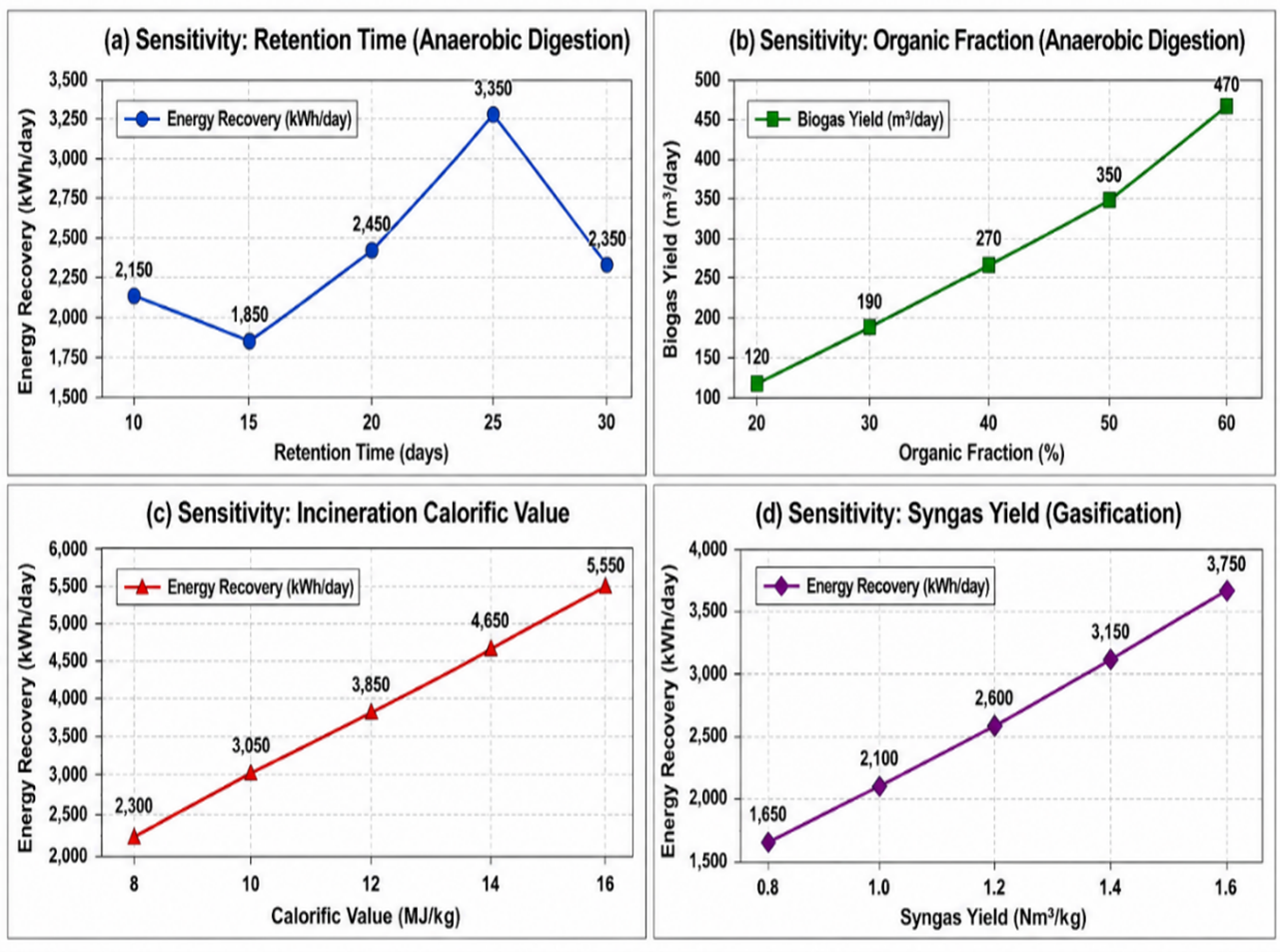
Municipal solid waste (MSW) management in developing cities is often assessed using waste-to-energy (WtE) models that emphasize technical parameters while overlooking segregation quality, ergonomic performance, and community participation. This study develops and validates a MATLAB-based framework that integrates these human-centered operational factors with waste composition and technology-specific conversion efficiencies. Palembang, Indonesia, was used as a case study because organic waste accounts for 63.45% of its MSW. The model combined waste characterization, proximate and ultimate analyses, and three conversion pathways: anaerobic digestion, incineration, and gasification. Energy recovery was evaluated under varying segregation, ergonomic, and participation scenarios, followed by sensitivity analysis and comparison with selected ASEAN city data. Under current collection conditions of 950-1.200 t/day, the hybrid system was estimated to produce approximately 358 GWh/year. Anaerobic digestion provided the most sustainable long-term contribution, while incineration and gasification supplied complementary recovery from high calorific fractions. Waste composition, segregation efficiency, and operational performance were the dominant determinants of energy output. The proposed framework improves the realism of conventional WtE assessments by quantitatively linking technical performance with ergonomic and community factors. The findings support source segregation, ergonomic waste handling systems, and decentralized anaerobic digestion as priority strategies for sustainable urban energy planning. The framework therefore offers a practical decision support tool for aligning waste management, renewable energy generation, and emission reduction.
References
Abubakar, I. R., Maniruzzaman, K. M., Dano, U. L., AlShihri, F. S., AlShammari, M. S., Ahmed, S. M. S., Al-Gehlani, W. A. G., & Alrawaf, T. I. (2022). Environmental Sustainability Impacts of Solid Waste Management Practices in the Global South. International Journal of Environmental Research and Public Health, 19(19), 12717. https://doi.org/10.3390/ijerph191912717
Agaton, C. B., & Santos, M. J. A. (2025). Social Acceptability of Waste-to-Energy: Research Hotspots, Technologies, and Factors. Clean Technologies, 7(3), 63. https://doi.org/10.3390/cleantechnol7030063
Amado, M., Barca, C., Hernández, M. A., & Ferrasse, J.-H. (2021). Evaluation of Energy Recovery Potential by Anaerobic Digestion and Dark Fermentation of Residual Biomass in Colombia. Frontiers in Energy Research, 9. https://doi.org/10.3389/fenrg.2021.690161
Aristizabal Cuellar, J. A., Puerto-Rojas, E., Correa-Galindo, S. N., & Sierra Puentes, M. C. (2025). A Community-Based Intervention Proposal for Municipal Solid Waste Management: Analyzing Willingness, Barriers and Spatial Strategies. Sustainability, 17(13), 6206. https://doi.org/10.3390/su17136206
Azis, M. M., Kristanto, J., & Purnomo, C. W. (2021). A Techno-Economic Evaluation of Municipal Solid Waste (MSW) Conversion to Energy in Indonesia. Sustainability, 13(13), 7232. https://doi.org/10.3390/su13137232
Bangura, A. M., & Kanty, P. F. (2024). The Impact of Solid Waste Generation, Storage and Separation Practices among Households on the Environment in Freetown. Journal of Geoscience and Environment Protection, 12(08), 219–238. https://doi.org/10.4236/gep.2024.128012
Baziar, M., Yousefi, M., Oskoei, V., Makhdoomi, A., Abdollahzadeh, R., & Dehghan, A. (2025). Machine learning-based prediction of heating values in municipal solid waste. Scientific Reports, 15(1), 14589. https://doi.org/10.1038/s41598-025-99432-8
Bongomin, O., Mwape, M. C., Mpofu, N. S., Bahunde, B. K., Kidega, R., Mpungu, I. L., Tumusiime, G., Owino, C. A., Goussongtogue, Y. M., Yemane, A., Kyokunzire, P., Malanda, C., Komakech, J., Tigalana, D., Gumisiriza, O., & Ngulube, G. (2025). Digital twin technology advancing industry 4.0 and industry 5.0 across sectors. Results in Engineering, 26, 105583. https://doi.org/10.1016/j.rineng.2025.105583
Cui, W., Wei, Y., & Ji, N. (2024). Global trends of waste-to-energy (WtE) technologies in carbon neutral perspective: Bibliometric analysis. Ecotoxicology and Environmental Safety, 270, 115913. https://doi.org/10.1016/j.ecoenv.2023.115913
Darmey, J., Ahiekpor, J. C., Narra, S., Achaw, O.-W., & Ansah, H. F. (2023). Municipal Solid Waste Generation Trend and Bioenergy Recovery Potential: A Review. Energies, 16(23), 7753. https://doi.org/10.3390/en16237753
Elroi, H., Zbigniew, G., Agnieszka, W.C., & Piotr, S. (2023). Enhancing waste resource efficiency: circular economy for sustainability and energy conversion. Frontiers in Environmental Science, 11. https://doi.org/10.3389/fenvs.2023.1303792
Elsha, W., & Budiarto, R. (2023). Comparative Study of Waste to Energy (WtE) Technology in Municipal Solid Waste Management (MSWM) in Yogyakarta. Journal of Industrial Engineering and Education. https://jiee.bksti.org/index.php/iee/article/view/19
Fragkos, P., Zisarou, E., & Andreou, A. (2024). Exploring the Impacts of Lifestyle Changes in the Global Energy Transition: Insights from a Model-Based Analysis Using PROMETHEUS. Climate, 12(12), 193. https://doi.org/10.3390/cli12120193
Gerassimidou, S., Velis, C. A., Williams, P. T., & Komilis, D. (2020). Characterisation and composition identification of waste-derived fuels obtained from municipal solid waste using thermogravimetry: A review. Waste Management & Research: The Journal for a Sustainable Circular Economy, 38(9), 942–965. https://doi.org/10.1177/0734242X20941085
Hartono, D. M. (2015). Potential reduction of solid waste generated from traditional and modern markets. In International Journal of Technology. academia.edu. https://www.academia.edu/download/89363177/448.pdf
Hoang, Q. N., Vanierschot, M., Blondeau, J., Croymans, T., Pittoors, R., & Van Caneghem, J. (2021). Review of numerical studies on thermal treatment of municipal solid waste in packed bed combustion. Fuel Communications, 7, 100013. https://doi.org/10.1016/j.jfueco.2021.100013
Islam, N. F., Gogoi, B., Saikia, R., Yousaf, B., Narayan, M., & Sarma, H. (2024). Encouraging circular economy and sustainable environmental practices by addressing waste management and biomass energy production. Regional Sustainability, 5(4), 100174. https://doi.org/10.1016/j.regsus.2024.100174
Maphuhla, N. G., & Oyedeji, O. O. (2025). From Trash to Treasure: Systematic Evaluation of Potential and Efficiency of Waste-to-Energy Incineration for Electricity Generation. Waste, 3(4), 39. https://doi.org/10.3390/waste3040039
Markova, P., Vreckova, D., Mikva, M., Szabo, P., & Cambal, M. (2025). The Impact of Ergonomic Rationalisation on the Efficiency and Productivity of the Production Process. Administrative Sciences, 15(2), 62. https://doi.org/10.3390/admsci15020062
Nanda, M. A., Sugandi, W., Wijayanto, A. K., Imantho, H., Sutawijaya, A., Nelwan, L. O., Budiastra, I. W., & Seminar, K. B. (2023). The Waste-to-Energy (WtE) Technology to Support Alternative Fuels for Agriculture in the Context of Effective Solid Waste Management in the Jabodetabek Area, Indonesia. Energies, 16(24), 7980. https://doi.org/10.3390/en16247980
Pambudi, N. A., Firdaus, R. A., Rizkiana, R., Ulfa, D. K., Salsabila, M. S., Suharno, & Sukatiman. (2023). Renewable Energy in Indonesia: Current Status, Potential, and Future Development. Sustainability, 15(3), 2342. https://doi.org/10.3390/su15032342
Primasari, I. A., & Budiyanto, T. (2025). Lean Ergonomic Approach to Ergonomic Risk Analysis for Workplace Assessment. LOGIC : Jurnal Rancang Bangun Dan Teknologi, 25(1), 35–44. https://doi.org/10.31940/logic.v25i1.35-44
Salem, K. S., Clayson, K., Salas, M., Haque, N., Rao, R., Agate, S., Singh, A., Levis, J. W., Mittal, A., Yarbrough, J. M., Venditti, R., Jameel, H., Lucia, L., & Pal, L. (2023). A critical review of existing and emerging technologies and systems to optimize solid waste management for feedstocks and energy conversion. Matter, 6(10), 3348–3377. https://doi.org/10.1016/j.matt.2023.08.003
Seah, C. C., Habib, S. H., Hafriz, R. S. R. M., Shamsuddin, A. H., Razali, N. M., & Salmiaton, A. (2024). Prospective energy content assessment of waste biomass and polymer via preliminary analysis. Results in Engineering, 22, 102301. https://doi.org/10.1016/j.rineng.2024.102301
Setiawan, H, Budiyanto, T., Rinamurti, M., & Alfian, A. (2025). Prototype Design of Ergo-Flexibility Wheelchair Based on Stakeholder Technical Requirements, Zachman Framework Approach, and Nigel Cross Method Integration. Spektrum Industri. https://doi.org/10.12928/si.v23i2.356
Setiawan, Heri, Bangun, F., Budiarto, D., & Pratama, Y. D. (2025). Assessing Waste Potential and Greenhouse Gas Emissions from Existing Waste Management Systems: A Case Study of Palembang City South Sumatera of Indonesia. Jurnal Improsci, 3(3), 156–171. https://doi.org/10.62885/improsci.v3i3.965
Setiawan, Heri, Susanto, S., Rinamurti, M., Alfian, A., Pratama, Y. D., & Budiarto, D. (2025). Work System Improvement in the Production Process Station Area PT SMS Using Macro Ergonomics and Design (MEAD) to Increase Productivity. Jurnal Improsci, 3(2), 80–94. https://doi.org/10.62885/improsci.v3i2.939
Shekari, A., Shishebori, D., Sadegheih, A., & Alidoosti, Z. (2025). Integrating energy justice principles in waste-to-energy conversion: A multi-criteria decision framework for sustainable urban waste management. Sustainable Futures, 10, 101175. https://doi.org/10.1016/j.sftr.2025.101175
Shovon, S. M., Akash, F. A., Rahman, W., Rahman, M. A., Chakraborty, P., Hossain, H. M. Z., & Monir, M. U. (2024). Strategies of managing solid waste and energy recovery for a developing country – A review. Heliyon, 10(2), e24736. https://doi.org/10.1016/j.heliyon.2024.e24736
Siahaan, G., Junianto, P., Pada, A. T., Sembiring, C. F., & Regina, D. (2023). Zero Waste Business Model: Building A Regenerative Business Model Through Innovation and Collaboration. International Journal of Science and Society, 5(4), 404–415. https://doi.org/10.54783/ijsoc.v5i4.795
Sohrabi, M. S., Khotanlou, H., Heidarimoghadam, R., Mohammadfam, I., Babamiri, M., & Soltanian, A. R. (2024). Modeling the Impact of Ergonomic Interventions and Occupational Factors on Work-Related Musculoskeletal Disorders in the Neck of Office Workers with Machine Learning Methods. Journal of Research in Health Sciences, 24(3), e00623. https://doi.org/10.34172/jrhs.2024.158
Suryawan, I. W. K., Septiariva, I. Y., Sari, M. M., Ramadan, B. S., Suhardono, S., Sianipar, I. M. J., Tehupeiory, A., Prayogo, W., & Lim, J.-W. (2023). Acceptance of Waste to Energy Technology by Local Residents of Jakarta City, Indonesia to Achieve Sustainable Clean and Environmentally Friendly Energy. Journal of Sustainable Development of Energy, Water and Environment Systems, 11(2), 1–17. https://doi.org/10.13044/j.sdewes.d11.0443
Taghipour, A., Foukolaei, P. Z., Ghaedi, M., & Khazaei, M. (2023). Sustainable Multi-Objective Models for Waste-to-Energy and Waste Separation Site Selection. Sustainability, 15(22), 15764. https://doi.org/10.3390/su152215764
Traven, L. (2023). Sustainable energy generation from municipal solid waste: A brief overview of existing technologies. Case Studies in Chemical and Environmental Engineering, 8, 100491. https://doi.org/10.1016/j.cscee.2023.100491
Utami, R., Khair, H., & Rachman, I. (2024). Waste-to-Energy Potential in Medan City, Indonesia: Challenges and Opportunities for Sustainable Urban Development. International Journal Of Scientific Advances, 5(6). https://doi.org/10.51542/ijscia.v5i6.41
Walczyk, G., & Ozadowicz, A. (2026). Digital Twin-Based Simulation of Smart Building Energy Performance: BIM-Integrated MATLAB/Simulink Framework for BACS and SRI Evaluation. Energies, 19(2), 543. https://doi.org/10.3390/en19020543
Zahrah, Y., Yu, J., & Liu, X. (2024). How Indonesia’s Cities Are Grappling with Plastic Waste: An Integrated Approach towards Sustainable Plastic Waste Management. Sustainability, 16(10), 3921. https://doi.org/10.3390/su16103921
Zhang, M., Nieuwenhuys, A., & Zhang, Y. (2025). Posture prediction models in digital human modeling for ergonomic design: A systematic review. Medical Engineering & Physics, 143(1), 104391. https://doi.org/10.1016/j.medengphy.2025.104391
Zhang, Z., Chen, Z., Zhang, J., Liu, Y., Chen, L., Yang, M., Osman, A. I., Farghali, M., Liu, E., Hassan, D., Ihara, I., Lu, K., Rooney, D. W., & Yap, P.-S. (2024). Municipal solid waste management challenges in developing regions: A comprehensive review and future perspectives for Asia and Africa. Science of The Total Environment, 930, 172794. https://doi.org/10.1016/j.scitotenv.2024.172794
Downloads
Published
Issue
Section
License
Copyright (c) 2026 Heri Setiawan, Theresia Sunarni, Achmad Alfian, Yohanes Dicka Pratama, Dominikus Budiarto, Bonifasius Ferdinandus Bangun, Deddy Permana, Micheline Rinamurti, Tri Budiyanto, Evelyn Agustin

This work is licensed under a Creative Commons Attribution-ShareAlike 4.0 International License.