Integrating Competitive Strategy and Sustainable Business Model Design for Retail Business Development
DOI:
https://doi.org/10.12928/si.v24i2.647Keywords:
Blue ocean strategy, Sustainable business model canvas, Triple layer business model canvas, Triple bottom line, Retail MSME’sAbstract
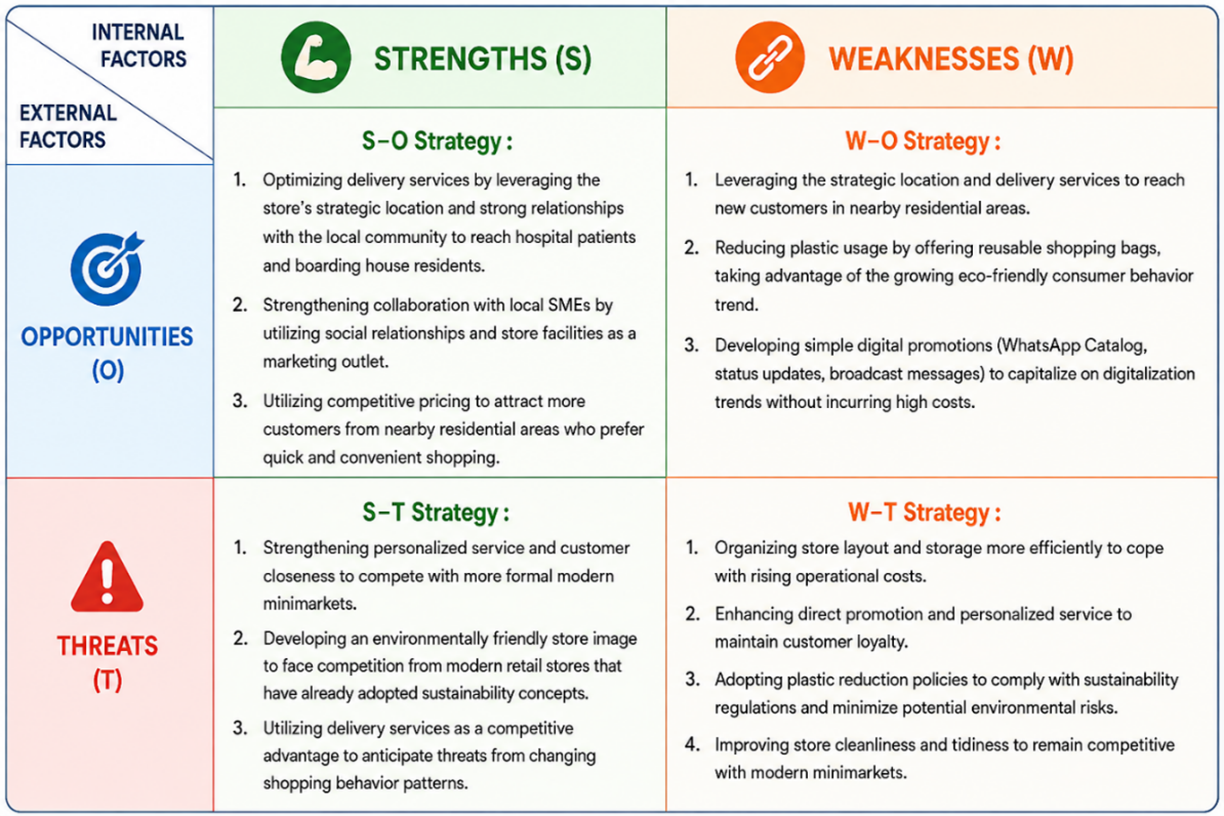
Retail MSMEs are increasingly challenged by competition from modern minimarkets, changing consumer shopping behavior, and growing sustainability expectations. Despite the widespread use of strategic analysis tools, studies integrating competitive strategy formulation with sustainable business model design remain limited, particularly for retail MSMEs. This study proposes an integrative framework for developing competitive and sustainable business strategies using evidence from Ridho Retail Store, a retail MSME in Indonesia. A mixed-method case study approach was employed, combining interviews, field observations, and business performance data. The findings indicate that Ridho Retail Store achieved an Internal Factor Evaluation (IFE) score of 2.70 and an External Factor Evaluation (EFE) score of 2.90, placing the business in Cell V of the IE Matrix, which suggests a hold and maintain strategy through gradual improvement. The proposed strategy emphasizes service differentiation through delivery services, stronger community engagement, and sustainability-oriented initiatives supported by a phased implementation roadmap. This study demonstrates how competitive strategy formulation can be systematically integrated with sustainable business model design to strengthen long-term competitiveness and sustainability in a retail MSME, providing a practical framework that can be adapted by similar small retail businesses.
References
Abbas, A. F., & Al-Lawati, E. H. (2026). Revisiting artificial intelligence in start-ups: A theoretical perspective on integration, opportunities, challenges, and strategic advancement. Journal of International Council for Small Business. https://doi.org/10.1080/26437015.2025.2549059
Abbas, S. (2026). Prevalence of the Shadow Economy in Asia: Investigating Major Causes and Mitigation Strategies. Journal of Public Affairs. https://doi.org/10.1002/pa.70161
Akbari, A. D., Sandika, S., Amran, T. G., & Yojana, R. M. (2025). Pengembangan Model Bisnis Pada Perusahaan Jasa Audio Visual Dengan Pendekatan Design Thinking. Jurnal Inovasi Teknik Industri. https://ejournal.unimugo.ac.id/index.php/JITIN/article/view/1639
Amirshenava, S., & Osanloo, M. (2022). Strategic planning of post-mining land uses: A semi-quantitative approach based on the SWOT analysis and IE matrix. Resources Policy, 76, 102585. https://doi.org/10.1016/j.resourpol.2022.102585
April, N., Salsabila, P., Lubis, I., & Salsabila, R. (2024). Peran UMKM ( Usaha Mikro , Kecil , Dan Menengah ) Dalam Meningkatkan Pembangunan Ekonomi Di Indonesia. 2(3).
Aqil, M. Y., Maharani, P. N., Wibowo, A., Andini, V. R., & Khalidah, I. S. (2024). SWOT Analysis for Business Strategy Development. Indonesian Journal of Innovation Multidisipliner Research, 2(4), 222–233. https://doi.org/10.69693/ijim.v2i4.231
Arora, M., Pareek, A., & Pareek, A. (2025). Innovating retail with AI: Emerging paradigms in the sharing economy. Innovation and the Sharing Economy. https://doi.org/10.4324/9781003535614-9
Baldivia, M., & Chowdhury, S. (2024). Adapting Business Models in the Age of Omnichannel Transformation: Evidence from the Small Retail Businesses in Australia. Journal of Theoretical and Applied Electronic Commerce Research, 20(1), 1. https://doi.org/10.3390/jtaer20010001
Basile, V. (2021). The Triple Layered Business Model Canvas in Smart Agriculture: the Case of Evja Startup. Piccola Impresa/Small Business, 2, 79–113. https://doi.org/10.14596/pisb.2844
Bezes, C. (2024). Small independent retailers: digitalize or disappear? An empirical study based on dynamic capabilities. International Journal of Retail & Distribution Management, 52(10/11), 1020–1037. https://doi.org/10.1108/IJRDM-10-2023-0630
Bingcheng, W., Yuxiang, Z., & Mengjie, C. (2024). Research on the impact of digital interaction on business model innovation. In Science Research Management. https://doi.org/10.19571/j.cnki.1000-2995.2024.06.014
Branchi, P., Fernandez-Valdivielso, C., & Matias, I. (2017). An Analysis Matrix for the Assessment of Smart City Technologies: Main Results of Its Application. Systems, 5(1), 8. https://doi.org/10.3390/systems5010008
Brunner, M., Bachmann, N., Thienemann, A.-K., Tuezuen, A., & Jodlbauer, H. (2025). To the end of the line – including intermediaries and end customers in the business model CANVAS. Journal of Open Innovation: Technology, Market, and Complexity, 11(3), 100623. https://doi.org/10.1016/j.joitmc.2025.100623
Campbell, D., Stonehouse, G., & Houston, B. (2003). Competitive advantage: strategies, knowledge and core competences. Business Strategy.
Chen, H., Hu, Y., & Hu, W. (2026). Designing Authentic Virtual Heritage Experiences for Sustainable Cultural Heritage Communication: A Mixed-Methods Study. In Sustainability. https://www.mdpi.com/2071-1050/18/15/7922
Chotisarn, N., & Phuthong, T. (2025). Retail technology use in sustainability practices: A mixed-methods analysis of implementation approaches and future directions. Sustainable Futures, 9, 100674. https://doi.org/10.1016/j.sftr.2025.100674
Do Vale, G., Collin-Lachaud, I., & Lecocq, X. (2025). Resolving paradoxical tensions during business model innovation for sustainability in retailing: The role of the ecosystem. Journal of Retailing, 101(4), 564–582. https://doi.org/10.1016/j.jretai.2025.06.001
Edeigba, J., & Arasanmi, C. (2022). An empirical analysis of SMES’ triple bottom line practices. Journal of Accounting & Organizational Change, 18(2), 238–259. https://doi.org/10.1108/JAOC-12-2020-0206
Evans, N., Stonehouse, G., & Campbell, D. (2019). Strategic management for travel and tourism. Routledge.
Fronda, J. G. (2025). Technology-based marketing strategies for retail growth and competitive positioning. International Journal of Advanced and Applied Sciences. https://doi.org/10.21833/ijaas.2025.11.024
Fuertes, G., Alfaro, M., Vargas, M., Gutierrez, S., Ternero, R., & Sabattin, J. (2020). Conceptual Framework for the Strategic Management: A Literature Review—Descriptive. Journal of Engineering, 2020, 1–21. https://doi.org/10.1155/2020/6253013
Ghofar, A., & Zawawi, Z. (2024). Optimalisasi Teknologi Digital Untuk Mencapai “UMKM Naik Kelas” Studi Kasus Toko Kelontong Kecamatan Genteng. Dengan mengadopsi sistem POS modern, misalnya, toko kelontong. Jurnal Manajemen Bisnis Digital Terkini. https://doi.org/10.61132/jumbidter.v1i3.237
Joyce, A., & Paquin, R. L. (2016). The triple layered business model canvas: A tool to design more sustainable business models. Journal of Cleaner Production, 135, 1474–1486. https://doi.org/10.1016/j.jclepro.2016.06.067
Kamalipour, Y. R., & Friedrichsen, M. (2017). Digital Transformation in Journalism and News Media. In Digital Transformation in Journalism and News Media. https://doi.org/10.1007/978-3-319-27786-8
Mallick, S. K., Rudra, S., & Samanta, R. (2020). Sustainable ecotourism development using SWOT and QSPM approach: A study on Rameswaram, Tamil Nadu. International Journal of Geoheritage and Parks, 8(3), 185–193. https://doi.org/10.1016/j.ijgeop.2020.06.001
Manalo, D. S., & Depante, L. A. (2025). Revisiting the Barangay Micro-Business Enterprises Act of 2002: A Policy Evaluation Using National-Level Data. Philippine Journal of Public Administration. https://www.econstor.eu/handle/10419/343029
Mazya, T., Kolopaking, L. M., Dharmawan, A. H., & Nurrochmat, D. R. (2022). Neue-Gemeinschaft: Digital transformation of micro, small and medium enterprises among rural community in Banyuwangi, East Java. Sodality: Jurnal Sosiologi Pedesaan. https://doi.org/10.22500/10202238533
Mostaghel, R., Oghazi, P., Parida, V., & Sohrabpour, V. (2022). Digitalization driven retail business model innovation: Evaluation of past and avenues for future research trends. Journal of Business Research, 146, 134–145. https://doi.org/10.1016/j.jbusres.2022.03.072
Mubarok, D. A. A., Oesman, I. F., Akbar, R. R., & Prasetiyo, W. G. (2026). Empowering Entrepreneurs With Disabilities By Enhancing Digital Marketing Skills Through E-Marketplace Design and Content Marketing Training. Inaba of Community Services Journal. https://doi.org/10.56956/2y8ef174
Myeni, S. H. (2025). Effectiveness of marketing strategies of tour operators in the promotion of small tourism enterprises in KwaZulu-Natal. African Journal of Hospitality Tourism and Leisure.
Ospina-Pinillos, L., Shambo-Rodríguez, D. L., & Hichie, I. B. (2025). Co-designing, developing, and testing a mental health platform for young people using a participatory design methodology in colombia: mixed methods study. In JMIR human Factors. https://doi.org/10.2196/66558
Patabang, A., Sanistasya, P. A., Arsyad, A. W., & Hikmah, M. (2025). Pemasaran Kewirausahaan dan Inovasi Hijau Terhadap UMKM Keberlanjutan: Pendekatan Analisis SWOT dan Uji Litmus. Social, Humanities, and Educational Studies (SHES): Conference Series, 8(2). https://doi.org/10.20961/shes.v8i2.105139
Patabang, A., Sanistasya, P. A., Arsyad, A. W., Hikmah, M., & Mulawarman, U. (2025). Pemasaran Kewirausahaan dan Inovasi Hijau Terhadap UMKM Keberlanjutan: Pendekatan Analisis SWOT dan Uji Litmus. Social, Humanities, and Educational Studies, 8(2), 458–472. https://doi.org/10.20961/shes.v8i2.105139
Putri, A. N. A., Hermawan, P., & Meadows. (2025). Exploring green growth in SMEs: Global trends, challenges, and future directions. In Foresight and STI Governance. https://doi.org/10.17323/fstig.2025.23708
Rahman, T., & Paul, S. K. (2025). The Evolution of Production Networks and Business Model Innovation in Global Value Chains. Global Value Chains and Geopolitical. https://doi.org/10.4324/9781003468899-5
Salwin, M., Jacyna-Golda, I., Kraslawski, A., & Waszkiewicz, A. E. (2022). The Use of Business Model Canvas in the Design and Classification of Product-Service Systems Design Methods. Sustainability, 14(7), 4283. https://doi.org/10.3390/su14074283
Subasinghe, S., Gamagedara, C., & Karunarathna, M. (2026). The Micro, Small, and Medium Enterprises (MSMEs) Research Landscape in the Region: Lessons for Sri Lanka’s Development Path. MSME Development in Sout and Southeast Asia. https://doi.org/10.4324/9781003666165-3
Sumiarti, Yulia, D., Iksal, N., Salsabila, N., Annisa, S., & Bayu, R. (2023). Analisis Matriks IFE dan Matriks EFE Pada UMKM Kerupuk Merah di Kecamatan Lubuk Begalung. Jurnal Pengabdian Masyarakat Bangsa, 1(5), 450–456. https://doi.org/10.59837/jpmba.v1i5.182
Ven, D. S. (2025). Automation-Enabled Micro Businesses in Phnom Penh, Cambodia. Cambodia (December 01, 2025). https://doi.org/10.2139/ssrn.7298741
Veranita, M., & Gunardi, G. (2023). Analisis Lingkungan Internal Dan Eksternal Untuk Perencanaan Strategi Bisnis : Studi Kasus Pada Umkm Della Bakery&Cake. Jurnal E-Bis, 7(1), 198–208. https://doi.org/10.37339/e-bis.v7i1.1191
Walker, C., & Hokkanen, H. (2024). Is the ‘Sustainable Retail Business Model’ a Pipedream?: A Multiple Case Study of Nordic Retailers. Journal of Business Models, 12(2). https://doi.org/10.54337/jbm.v12i2.8842
Zhenbin, W., Ramachandran, S., Siow, M., & Hui, Z. (2026). Exploring the formation of behavioral intention toward rural tourism via sensory experience and memorable tourism experiences, a case study in Henan, China. Journal of Quality Assurance in Hospitality & Tourism. https://doi.org/10.1080/1528008X.2024.2390493
Downloads
Published
Issue
Section
License
Copyright (c) 2026 Muhammad Ridho Febrianto, Wawan Kurniawan, Annisa Dewi Akbari, Emilia Sari, Ratna Mira Yojana, Anas Saifurrahman

This work is licensed under a Creative Commons Attribution-ShareAlike 4.0 International License.