From Static Risk Lists to Dynamic Risk Behavior: An Integrated Mixed-Method and Causal Loop Modeling Approach for Operational Risk in Indonesian EPC Firms
DOI:
https://doi.org/10.12928/si.v24i2.670Keywords:
Causal loop diagram, EPC companies, Mixed-method, Operational risk, Risk dynamicsAbstract
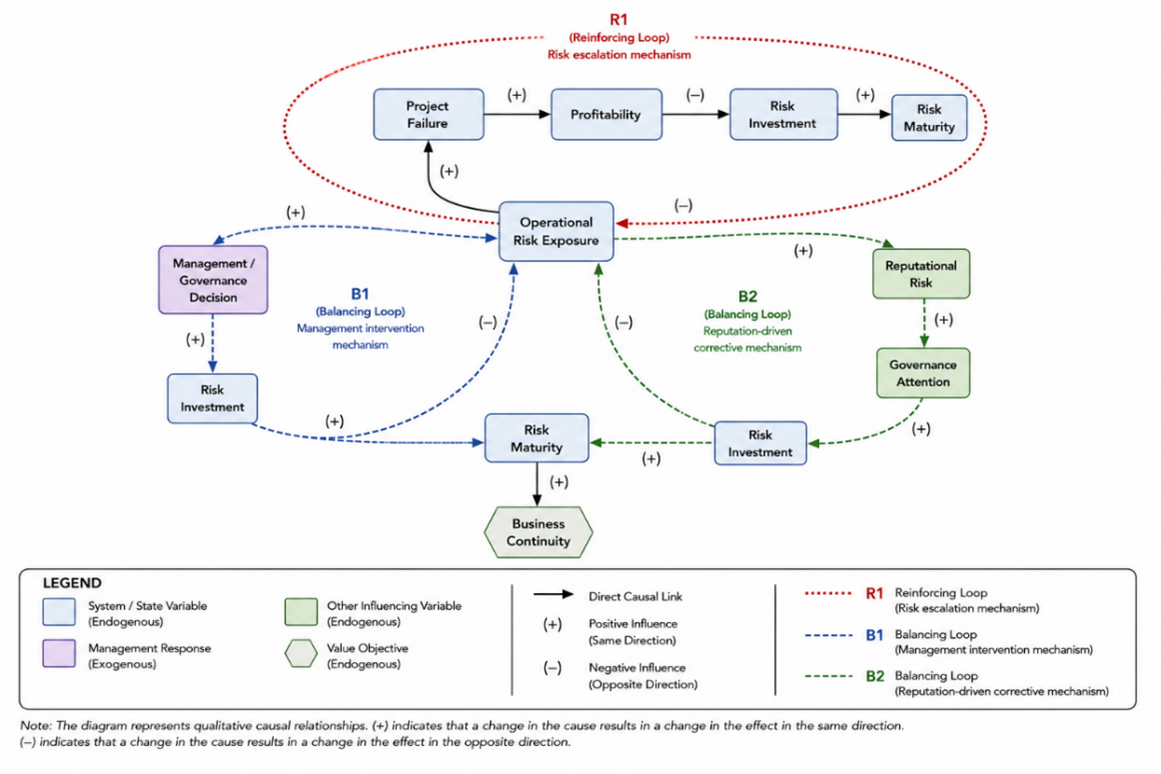
Operational risks in Engineering, Procurement, and Construction (EPC) firms are interconnected and may evolve through interactions among organizational, project, and external factors. However, conventional risk assessment approaches often emphasize risk identification and prioritization without explicitly representing potential feedback relationships among risk factors. This study develops a qualitative causal framework for operational risk in Indonesian EPC firms by integrating expert-based risk-dimension validation with systems thinking and Causal Loop Diagram (CLD) modelling. The study employed a sequential two-stage approach. First, a structured literature synthesis identified 15 operational risk dimensions, which were operationalized into 45 measurement items and assessed by seven EPC experts using Content Validity Ratio (CVR), Content Validity Index (CVI), and Relative Importance Index (RII). Five core dimensions were retained: Strategic & Business Risk, Human Resource Risk, Customer & Stakeholder Risk, Environmental & Sustainability Risk, and Reputational Risk. Second, the validated dimensions were incorporated into an influence diagram and subsequently developed into a CLD. Causal directions and polarities were established through conceptual definitions, EPC operational knowledge, risk-management principles, and expert-based structural verification rather than inferred from CVR, CVI, or RII results. The resulting CLD identifies one potential reinforcing mechanism associated with risk escalation and two potential balancing mechanisms associated with governance-based and reputation-driven corrective responses. The study contributes an expert-verified qualitative causal architecture that extends operational risk assessment from variable identification toward a systems-based representation of potential feedback mechanisms. Historical pattern assessment showed directional consistency for 13 of 14 loop-specific causal relationship instances, with R1 partially supported and B1 and B2 showing consistent historical patterns.
References
Almanasreh, E., Moles, R. J., & Chen, T. F. (2022). A practical approach to the assessment and quantification of content validity. In Contemporary Research Methods in Pharmacy and Health Services (pp. 583–599). https://doi.org/10.1016/B978-0-323-91888-6.00013-2
Alsarayreh, R., Buraik, O., Hijazin, A., & Alshdaifat, S. M. (2025). The impact of business intelligence on strategic ambidexterity: The mediating role of knowledge sharing. In Electronic Journal of e-Learning (EJEL). https://doi.org/10.34190/ejbrm.23.1.3719
Antunes, R., & Gonzalez, V. (2015). A Production Model for Construction: A Theoretical Framework. Buildings, 5(1), 209–228. https://doi.org/10.3390/buildings5010209
Awang Ali, Q. S., Hanafiah, M. H., & Mogindol, S. H. (2023). Systematic literature review of Business Continuity Management (BCM) practices: Integrating organisational resilience and performance in Small and medium enterprises (SMEs) BCM framework. International Journal of Disaster Risk Reduction, 99, 104135. https://doi.org/10.1016/j.ijdrr.2023.104135
Ayu, W. D., Nugroho, N., & Just’at, I. (2024). The Influence of Knowledge and Leadership on Clinical Risk Management with Patient Safety Culture as an Intervening Variable at PMI Hospital. Jurnal Mahasiswa Ilmu Kesehatan. https://jurnal.stikes-ibnusina.ac.id/index.php/jumkes/article/view/1859
Bromiley, P., McShane, M., Nair, A., & Rustambekov, E. (2015). Enterprise Risk Management: Review, Critique, and Research Directions. Long Range Planning, 48(4), 265–276. https://doi.org/10.1016/j.lrp.2014.07.005
Chien, K.-F., Wu, Z.-H., & Huang, S.-C. (2014). Identifying and assessing critical risk factors for BIM projects: Empirical study. Automation in Construction, 45, 1–15. https://doi.org/10.1016/j.autcon.2014.04.012
Chigbu, B. I., & Makapela, S. L. (2025). Data-driven leadership in higher education: advancing sustainable development goals and inclusive transformation. In Sustainability. https://doi.org/10.3390/su17073116
Davies, A., & Mackenzie, I. (2014). Project complexity and systems integration: Constructing the London 2012 Olympics and Paralympics Games. International Journal of Project Management, 32(5), 773–790. https://doi.org/10.1016/j.ijproman.2013.10.004
Dong, S., Ahmed, M., & Chatpattananan, V. (2025). Analysis of Key Factors of Cost Overrun in Construction Projects Based on Structural Equation Modeling. Sustainability, 17(5), 2119. https://doi.org/10.3390/su17052119
Francisco de Oliveira, G., & Rabechini Jr, R. (2019). Stakeholder management influence on trust in a project: A quantitative study. International Journal of Project Management, 37(1), 131–144. https://doi.org/10.1016/j.ijproman.2018.11.001
Hanay, U., Ince, H., & Isik, G. (2024). Identifying Key Factors of Reputational Risk in Finance Sector Using a Linguistic Fuzzy Modeling Approach. Systems, 12(10), 440. https://doi.org/10.3390/systems12100440
Huang, R., & Wang, Z. (2025). Internal Control and Risk Management in Accounting Information System. International Journal of Information Systems in the Service Sector, 16(1), 1–17. https://doi.org/10.4018/IJISSS.392475
Hwang, B., & Tan, J. S. (2012). Green building project management: obstacles and solutions for sustainable development. Sustainable Development, 20(5), 335–349. https://doi.org/10.1002/sd.492
Ivanov, D., & Dolgui, A. (2020). Viability of intertwined supply networks: extending the supply chain resilience angles towards survivability. A position paper motivated by COVID-19 outbreak. International Journal of Production Research, 58(10), 2904–2915. https://doi.org/10.1080/00207543.2020.1750727
Jian, F., Liu, Q., Feng, C., Hu, Q., Yu, Q., & Guo, Q. (2025). Critical Factors Affecting Construction Labor Productivity: A Systematic Review and Meta-Analysis. Buildings, 15(14), 2463. https://doi.org/10.3390/buildings15142463
Kabirifar, K., & Mojtahedi, M. (2019). The impact of Engineering, Procurement and Construction (EPC) Phases on Project Performance: A Case of Large-scale Residential Construction Project. Buildings, 9(1), 15. https://doi.org/10.3390/buildings9010015
Khatib, B. Al, Poh, Y. S., & El-Shafie, A. (2020). Delay Factors Management and Ranking for Reconstruction and Rehabilitation Projects Based on the Relative Importance Index (RII). Sustainability, 12(15), 6171. https://doi.org/10.3390/su12156171
Khoa, V. D., & Chinda, T. (2023). Assessment of Construction Competitiveness through Knowledge Management Process Implementation. Sustainability, 15(22), 15897. https://doi.org/10.3390/su152215897
Love, P. E. D., Matthews, J., Sing, M. C. P., Porter, S. R., & Fang, W. (2022). State of Science: Why Does Rework Occur in Construction? What Are Its Consequences? And What Can be Done to Mitigate Its Occurrence? Engineering, 18, 246–258. https://doi.org/10.1016/j.eng.2022.05.010
Marle, F., & Vidal, L.-A. (2016). Managing Complex, High Risk Projects. Springer London. https://doi.org/10.1007/978-1-4471-6787-7
Mochamad Agung Wibowo, & Marah Ali Ammar. (2025). Lean construction and sustainability: A review of research trends and implications for the United Nations SDGs. E3S Web of Conferences, 605, 03048. https://doi.org/10.1051/e3sconf/202560503048
Moon, D., & Krahel, J. P. (2020). Continuous Risk Monitoring and Assessment: New Component of Continuous Assurance. Journal of Emerging Technologies in Accounting, 17(2), 173–200. https://doi.org/10.2308/JETA-18-01-09-1
Nurhidayat, A. E., Fitriana, R., Suhardini, D., & Nugrahanti, A. (2024). The causal loop diagram model of traceability system rental equipment in oil and gas supporting companies. TELKOMNIKA (Telecommunication Computing Electronics and Control), 22(5), 1104. https://doi.org/10.12928/telkomnika.v22i5.26084
O’Sullivan, S. L. (2010). International human resource management challenges in Canadian development INGOs. European Management Journal, 28(6), 421–440. https://doi.org/10.1016/j.emj.2010.06.006
Oesterreich, T. D., & Teuteberg, F. (2016). Understanding the implications of digitisation and automation in the context of Industry 4.0: A triangulation approach and elements of a research agenda for the construction industry. Computers in Industry, 83, 121–139. https://doi.org/10.1016/j.compind.2016.09.006
Oktafiansyah, T., & Patriadi, A. (2025). Analysis of Project Delay Impacts on Time and Cost In Elevator Work For A 10-Story Office Building Construction Project. Devotion: Journal of Research & Community Service. https://doi.org/10.59188/devotion.v6i3.25437
Pinho, H. de. (2015). Participant Guidelines. System Tools for Complex Health Systems: A Guide to Creating Causal Loop Diagrams [Internet]. New York City: Mailman School. Columbia University.
Sabri, O. K., Dovland, M., & Daae, F. (2025). Understanding Owner–Contractor Conflicts in State Building and Infrastructure Projects: A Case Study of Norway. Buildings, 15(7), 1135. https://doi.org/10.3390/buildings15071135
Samad, N., Mansor, M., Mohd Noor, M. A., & & Jumahat, T. (2023). Measuring the Content Validity of Middle Leadership Competence Model using Content Validity Ratio (CVR) Analysis. International Journal of Business and Technology Management. https://doi.org/10.55057/ijbtm.2023.5.4.12
Shahzad, A., Terziovski, M., & Sandhu, M. A. (2026). Benchmarking an integrative project management model to enhance the effectiveness of EPC projects through the adoption of digital technology. … : An International Journal. https://doi.org/10.1108/BIJ-12-2023-0912/1275430
Shrotryia, V. K., & Dhanda, U. (2019). Content Validity of Assessment Instrument for Employee Engagement. Sage Open, 9(1). https://doi.org/10.1177/2158244018821751
Smith, C. L., & Brooks, D. J. (2013). Knowledge Management. In Security Science (pp. 177–198). Elsevier. https://doi.org/10.1016/B978-0-12-394436-8.00008-4
Soltanizadeh, S., Abdul Rasid, S. Z., Mottaghi Golshan, N., & Wan Ismail, W. K. (2016). Business strategy, enterprise risk management and organizational performance. Management Research Review, 39(9), 1016–1033. https://doi.org/10.1108/MRR-05-2015-0107
Subiyanto, E. (2021). Investigating the logistics costs model: recent update in Indonesia. Journal of Science and Technology Policy Management. https://doi.org/10.1108/JSTPM-03-2020-0034
Sultana, S., Paul, N., Tasmin, M., Dutta, A. K., & Khan, S. A. (2024). Analyzing Supply Chain Risks and Resilience Strategies: A Systematic Literature Review. 1st International Conference on Industrial, Manufacturing, and Process Engineering (ICIMP-2024), 41. https://doi.org/10.3390/engproc2024076041
Too, E. G., & Weaver, P. (2014). The management of project management: A conceptual framework for project governance. International Journal of Project Management, 32(8), 1382–1394. https://doi.org/10.1016/j.ijproman.2013.07.006
Torabi, S. A., Rezaei Soufi, H., & Sahebjamnia, N. (2014). A new framework for business impact analysis in business continuity management (with a case study). Safety Science, 68, 309–323. https://doi.org/10.1016/j.ssci.2014.04.017
Wang, N., Xu, Z., & Liu, Z. (2023). Innovation in the construction sector: Bibliometric analysis and research agenda. Journal of Engineering and Technology Management, 68, 101747. https://doi.org/10.1016/j.jengtecman.2023.101747
Xia, M., Zhao, L., & Zhao, L. (2022). A Comprehensive Risk-Assessment Method for Prefabricated Buildings Using EPC: A Case Study from China. Sustainability, 14(3), 1910. https://doi.org/10.3390/su14031910
Yang, Y., Huang, Z., Chen, Y., Luo, L., & Li, F. (2026). Strategies for optimizing EPC project cost management via analytic hierarchy process: a case study approach. Journal of Asian Architecture and Building Engineering, 25(4), 3439–3453. https://doi.org/10.1080/13467581.2025.2505793
Yuan, M., Li, Z., Li, X., & Luo, X. (2021). Managing stakeholder-associated risks and their interactions in the life cycle of prefabricated building projects: A social network analysis approach. Journal of Cleaner Production, 323, 129102. https://doi.org/10.1016/j.jclepro.2021.129102
Zhang, Z., Duan, L., & Du, X. (2025). Risk Assessment of Prefabricated Building Projects Based on the G1-CRITIC Method and Cloud Model: A Case Study from China. In Buildings. https://doi.org/10.3390/buildings15152787
Downloads
Published
Issue
Section
License
Copyright (c) 2026 Drajat Indrajaya, Parwadi Moengin, Dadang Surjasa, Sally Cahyati, Etanto Heiliano Wijayanto

This work is licensed under a Creative Commons Attribution-ShareAlike 4.0 International License.