A Hybrid Stochastic Optimization and Simulation Approach for Multi-Stage Production–Procurement Planning under Uncertainty
DOI:
https://doi.org/10.12928/si.v24i2.679Keywords:
Purchasing optimization, Production scheduling, Monte Carlo scenario, Stochastic optimization, Textile industryAbstract
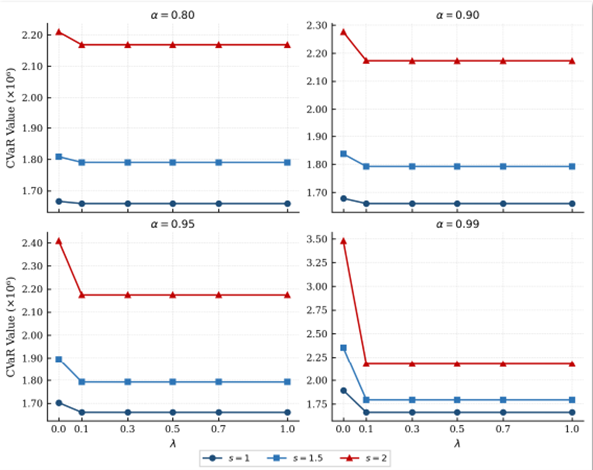
Multi-stage manufacturing firms that source raw materials through both long-lead-time import contracts and volatile spot markets must coordinate procurement and production under supply and demand uncertainty. Managing these decisions separately leads to excessive reliance on spot markets, unstable inventories, and unbuffered downside cost risk. This study aims to develop a novel integrated stochastic optimization framework that jointly plans procurement and multi-stage production for a real-world textile supply chain. The framework's novelty lies in embedding a Conditional Value-at-Risk (CVaR) measure directly into a multi-stage stochastic input–output production–procurement model, so that sourcing-channel selection and production scheduling are optimized jointly rather than sequentially. The approach combines a risk-aware CVaR procurement model with a stochastic input–output production scheduling model that captures material flow across processing stages. The two are accompanied by a Monte Carlo scenario-generation architecture that represents demand and spot-price uncertainty. System performance is evaluated across 100 stochastic scenarios over a 52-week horizon, using a dataset calibrated from an industrial textile system. Results show the framework maintains a 100% service level (zero expected backlog) across all scenarios. As the initial-inventory target rises from 1× to 2× the target Days of Inventory on Hand (DOH), total operational cost increases from about USD 2.15 million to USD 2.80 million (a 30% rise), while the 0.95-level CVaR increases from about USD 1.66 million to USD 2.17 million. This reveals an explicit, quantifiable trade-off between inventory buffering and downside cost risk. The model also shifts sourcing away from expensive spot purchasing as buffering increases. This study contributes to developing a framework that offers a practical, risk-aware decision-support tool for firms balancing import contracts against spot volatility, and demonstrates the value of synchronizing procurement and production rather than planning them in isolation.
References
Achaw, O. W., & Danso-Boateng, E. (2021). Textile and fabric manufacture. Chemical and Process Industries: With Examples of Industries in Ghana. https://doi.org/10.1007/978-3-030-79139-1_3
Alamirew, A. T., & Tesema, G. B. (2024). Optimizing Carding Speed Parameters and C-60 RSB Draft to Improve Sliver Quality. Journal of Natural Fibers. https://doi.org/10.1080/15440478.2024.2337044
Basu, A. (2025). Compact spinning: new developments. Developments in Yarn Spinning Technologies. https://doi.org/10.1016/B978-0-443-13887-4.00005-3
Birge, J. R., & Louveaux, F. (2011). Introduction to Stochastic Programming. Springer New York. https://doi.org/10.1007/978-1-4614-0237-4
Camargo, V. C. B., Almada-Lobo, B., & Toledo, F. M. B. (2021). Integrated Lotsizing, Scheduling And Blending Decisions In The Spinning Industry. Pesquisa Operacional, 41(spe). https://doi.org/10.1590/0101-7438.2021.041s1.00233486
Choi, T. Y., Netland, T. H., Sanders, N., Sodhi, M. S., & Wagner, S. M. (2023). Just-in-time for supply chains in turbulent times. Production and Operations Management, 32(7), 2331–2340. https://doi.org/10.1111/poms.13979
Corsini, R. R., Costa, A., Fichera, S., & Framinan, J. M. (2024). Digital twin model with machine learning and optimization for resilient production–distribution systems under disruptions. Computers & Industrial Engineering, 191, 110145. https://doi.org/10.1016/j.cie.2024.110145
Goyal, A. (2021). Management of spinning and weaving wastes. Waste Management in the Fashion and Textile Industries. https://doi.org/10.1016/B978-0-12-818758-6.00003-X
Guzman, E., Andres, B., & Poler, R. (2022). Models and algorithms for production planning, scheduling and sequencing problems: A holistic framework and a systematic review. Journal of Industrial Information Integration, 27, 100287. https://doi.org/10.1016/j.jii.2021.100287
He, Zhenglei, Xu, J., Tran, K. P., Thomassey, S., Zeng, X., & Yi, C. (2021). Modeling of textile manufacturing processes using intelligent techniques: a review. The International Journal of Advanced Manufacturing Technology, 116(1–2), 39–67. https://doi.org/10.1007/s00170-021-07444-1
He, Zhiliang, Thürer, M., & Zhou, W. (2024). The use of reinforcement learning for material flow control: An assessment by simulation. International Journal of Production Economics, 274, 109312. https://doi.org/10.1016/j.ijpe.2024.109312
Islam, M. R., Hasan, A. Al, Afrose, T. D., Hasan, M. S., & Sikdar, H. (2024). Sustainable development of three distinct starch based bio-composites reinforced with the cotton spinning waste collected from fiber preparation stage. In Heliyon. https://doi.org/10.1016/j.heliyon.2024.e31534
Ivanov, D., & Dolgui, A. (2022). The shortage economy and its implications for supply chain and operations management. International Journal of Production Research, 60(24), 7141–7154. https://doi.org/10.1080/00207543.2022.2118889
Jayalath, M. M., Perera, H. N., Ratnayake, R. M. C., & Thibbotuwawa, A. (2025). Harvesting sustainability: Transforming traditional agri-food supply chains with circular economy in developing economies. In Cleaner Waste. https://doi.org/10.1016/j.clwas.2025.100264
Kanon, T. A., Rashid, M. E., Haque, R. U., Islam, M. A., & Khan, M. R. (2023). Double air suctioned carding process: A method for achieving improved quality ring-spun carded yarn. In Heliyon. https://doi.org/10.1016/j.heliyon.2023.e13096
Khare, A. R. (2021). Principles of spinning: fibres and blow room cotton processing in spinning.
Kim, D.-H., Kim, G.-Y., & Noh, S. Do. (2025). Digital Twin-Based Prediction and Optimization for Dynamic Supply Chain Management. Machines, 13(2), 109. https://doi.org/10.3390/machines13020109
Liang, T., Zhou, L., & Jiang, Z. (2025). Integrated scheduling of production and material delivery for the intelligent manufacturing system. International Journal of Production Research, 63(3), 882–903. https://doi.org/10.1080/00207543.2024.2363435
Merzifonluoglu, Y. (2026). Procurement portfolio management for resilient supply chains: value of information for risk averse decision making. Annals of Operations Research, 356(2–3), 1059–1088. https://doi.org/10.1007/s10479-024-05918-5
Mohammadivojdan, R., Merzifonluoglu, Y., & Geunes, J. (2022). Procurement portfolio planning for a newsvendor with supplier delivery uncertainty. European Journal of Operational Research, 297(3), 917–929. https://doi.org/10.1016/j.ejor.2021.05.026
Nalimov, V. V., & Mulchenko, Z. M. (1971). Measurement of Science. Study of the Development of Science as an Information Process. Foreign Technology Division.
Parchami Afra, A., Kheirkhah, A., & Ahadi, H. (2022). Systematic literature review of integrated project scheduling and material ordering problem: Formulations and solution methods. Computers & Industrial Engineering, 173, 108711. https://doi.org/10.1016/j.cie.2022.108711
Raj, A., Mukherjee, A. A., de Sousa Jabbour, A. B. L., & Srivastava, S. K. (2022). Supply chain management during and post-COVID-19 pandemic: Mitigation strategies and practical lessons learned. Journal of Business Research, 142, 1125–1139. https://doi.org/10.1016/j.jbusres.2022.01.037
Rockafellar, R. T., & Uryasev, S. (2000). Optimization of conditional value-at-risk. The Journal of Risk, 2(3), 21–41. https://doi.org/10.21314/JOR.2000.038
Taghavi, S. M., Ghezavati, V., Bidhandi, H. M., & Al-e-Hashem, S. M. J. M. (2023). Green-Resilient Supplier Selection and Order Allocation Under Disruption by Utilizing Conditional Value at Risk: Mixed Response Strategies. Process Integration and Optimization for Sustainability, 7(1–2), 359–380. https://doi.org/10.1007/s41660-022-00298-4
Talaba, N. A., & Koo, P.-H. (2025). Portfolio Procurement Strategies with Forward and Option Contracts Combined with Spot Market. Systems, 13(3), 210. https://doi.org/10.3390/systems13030210
Thurer, M., Fernandes, N. O., Lodding, H., & Stevenson, M. (2025). Material flow control in make-to-stock production systems: an assessment of order generation, order release and production authorization by simulation. Flexible Services and Manufacturing Journal, 37(1), 1–37. https://doi.org/10.1007/s10696-024-09532-2
Thurer, M., Fernandes, N. O., & Stevenson, M. (2022). Production planning and control in multi-stage assembly systems: an assessment of Kanban, MRP, OPT (DBR) and DDMRP by simulation. International Journal of Production Research, 60(3), 1036–1050. https://doi.org/10.1080/00207543.2020.1849847
Xu, W., & Song, D.-P. (2022). Integrated optimisation for production capacity, raw material ordering and production planning under time and quantity uncertainties based on two case studies. Operational Research, 22(3), 2343–2371. https://doi.org/10.1007/s12351-020-00609-y
Yeshzhanov, A., Murzabayeva, G., & Togataev, T. (2024). The influence of increasing the productivity of the carding machine on the quality indicators of the card sliver. E3S Web of Conferences. https://doi.org/10.1051/e3sconf/202447401024
Zamani D. D., Moradi, S., & Alizadeh, B. (2023). Simultaneous planning of purchase orders, production, and inventory management under demand uncertainty. International Journal of Production Economics, 265, 109012. https://doi.org/10.1016/j.ijpe.2023.109012
Zhang, Y., Huang, M., Tian, L., Jin, D., & Cai, G. (2021). Build or join a sharing platform? The choice of manufacturer’s sharing mode. International Journal of Production Economics, 231, 107811. https://doi.org/10.1016/j.ijpe.2020.107811
Downloads
Published
Issue
Section
License
Copyright (c) 2026 Paulina Kus Ariningsih, Carles Sitompul, Titi Iswari, Giovano Alberto

This work is licensed under a Creative Commons Attribution-ShareAlike 4.0 International License.