Optimizing LPG Distribution Resilience: A Fuzzy-Heuristic Approach and Monte Carlo Simulation for Single-Manifold Bottleneck Mitigation in Refinery Facilities
DOI:
https://doi.org/10.12928/si.v24i2.686Keywords:
LPG Distribution, Monte Carlo simulation, Heuristic priority rule, Fuzzy logic, Single-manifold bottleneckAbstract
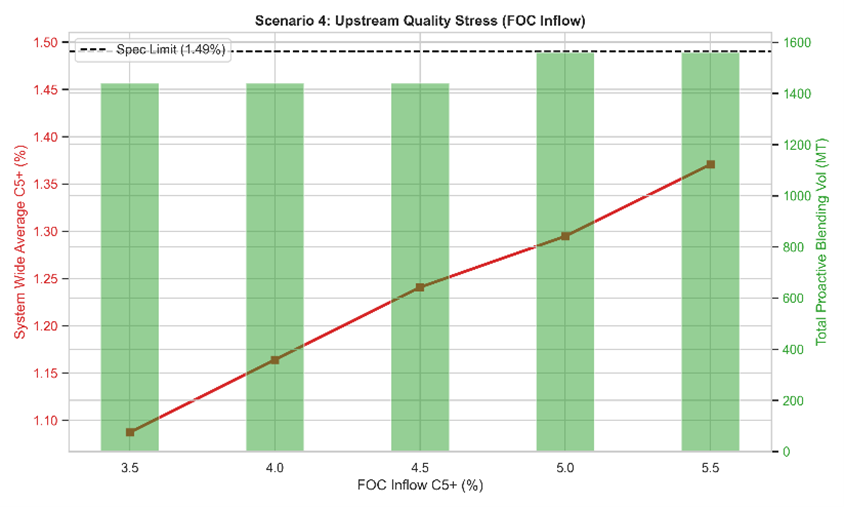
Operational bottlenecks in LPG refinery distribution can arise from single-manifold constraints, creating a critical trade-off between throughput maximization and product quality assurance. Existing scheduling approaches often address vessel evacuation and blending separately, leaving a gap in integrated decision models that simultaneously consider infrastructure constraints, production fluctuations, and quality specifications. This study aims to develops an integrated simheuristic decision-support framework combining a five-tier Lexicographic Heuristic Priority Rule, Fuzzy Logic membership functions, and a Zero-Sealing mechanism to prevent off-specification products from entering distribution. The framework enables refinery managers to determine achievable throughput through a single manifold while maintaining product quality. A discrete-event simulation with hourly time steps was developed over a 31-day operational horizon using historical vessel arrival, distribution, and production data from a refinery case. Model performance was evaluated through Monte Carlo simulation under four uncertainty dimensions: maritime arrival variability, batch-size variation, pipeline degradation, and upstream feed-quality fluctuations. Sensitivity analysis was conducted to identify critical operational thresholds. Across the tested scenarios, the framework recorded no overfill incidents or quality specification violations and achieved a mean domestic gas supply of approximately 1,355 MT/day, evacuating nearly all available upstream production. Pipeline rate degradation was identified as the most sensitive parameter, affecting both throughput evacuation and quality control when capacity declined below a critical level. The findings demonstrate that evacuation capacity and quality management are structurally interdependent in single-manifold systems. The proposed framework contributes provides a quantitative decision-support tool for reducing off-specification risks and informing refinery infrastructure investment decisions.
References
Agbaji, A. L., Morrison, R., & Lakshmanan, S. (2023, June 5). ESG, Sustainability and Decarbonization: An Analysis of Strategies and Solutions for the Energy Industry. SPE EuropEC - Europe Energy Conference Featured at the 84th EAGE Annual Conference & Exhibition. https://doi.org/10.2118/214346-MS
Ahmednooh, M., & Menezes, B. (2024). Blend Scheduling Solutions in Petroleum Refineries towards Automated Decision-Making in Industrial-like Blend-Shops. Processes, 12(3), 561. https://doi.org/10.3390/pr12030561
Akintayo, V. O., Jian-tang, X., Han, L., Zepeng, A., & Pingping, F. (2026). mHTMapping and identifying candidate genes enabling lead (Pb) accumulation and tolerance in Dark Jute (Corchorus olitorius L.) as revealed by BSA-seq and RNA-seq. In Industrial Crops and Products. https://doi.org/10.1016/j.indcrop.2025.122558
Ardekani, M. A. (2022). A Multi-Objective Supply Chain Configuration for the Oil Industry under Uncertainty. Advances in Industrial Engineering. https://doi.org/10.1051/ro/2021158
Awan, M. A. H., Naseem, A., Ahsan, A., Shahzad, A., Ullah, M., & Sadiq, A. S. (2025). Evaluating disruption scenarios for improving downstream oil supply chain resilience and cost minimization using Monte Carlo simulation. Scientific Reports, 15(1), 38910. https://doi.org/10.1038/s41598-025-22678-9
Bakon, K., Holczinger, T., Sule, Z., Jasko, S., & Abonyi, J. (2022). Scheduling Under Uncertainty for Industry 4.0 and 5.0. IEEE Access, 10, 74977–75017. https://doi.org/10.1109/ACCESS.2022.3191426
Chen, L., Yang, W., Qiu, K., & Dauzere-Peres, S. (2023). A lexicographic optimization approach for a bi-objective parallel-machine scheduling problem minimizing total quality loss and total tardiness. Computers & Operations Research, 155, 106245. https://doi.org/10.1016/j.cor.2023.106245
Eldawody, S., Nassar, K., & Essawy, Y. A. S. (2025). Activity Sequencing Optimization in Petroleum Projects Using Simulation Modeling. Modular and Offsite Construction (MOC) Summit Proceedings, 34–41. https://doi.org/10.29173/mocs311
Eles, A., & Heckl, I. (2025). Efficient Simulation Algorithm and Heuristic Local Optimization Approach for Multiproduct Pipeline Networks. Logistics, 9(3), 114. https://doi.org/10.3390/logistics9030114
Fang, W., Du, W., Yu, G., He, R., Tang, Y., & Jin, Y. (2025). Preference Prediction-Based Evolutionary Multiobjective Optimization for Gasoline Blending Scheduling. IEEE Transactions on Artificial Intelligence, 6(1), 79–92. https://doi.org/10.1109/TAI.2024.3444736
Fernando, M., & Sigera, I. (2021). Assessing the Oil Supply Chain Risk in Sri Lankan Petroleum Industry. 2021 Moratuwa Engineering Research Conference (MERCon), 374–379. https://doi.org/10.1109/MERCon52712.2021.9525691
Hasan, J., Thomas, A., & Tomos, O. (2024). Sustainable Supply Chain Practices in the Oil and Gas Industry: A Case Study. Sustainability, 16(5), 1720. https://doi.org/10.3390/su16051720
Hu, X., Li, J., Li, F., Wang, J., & Wang, Y. (2025). Priority rule-based heuristics for distributed multi-project scheduling considering global resource failures. Journal of the Operational Research Society, 76(10), 2112–2131. https://doi.org/10.1080/01605682.2025.2457655
Hua, J., Chen, Q., Liu, W., He, R., Li, Q., & Zhu, Z. (2023). Optimization and Application of Gasoline Blending Multi-period Scheduling Considering Blending Effect. 2023 2nd International Conference on Advanced Sensing, Intelligent Manufacturing (ASIM), 66–70. https://doi.org/10.1109/ASIM62342.2023.00020
Junior, M. C. L. (2022). Scheduling optimization applied to the electricity, oil and gas industries. theses.hal.science. https://theses.hal.science/tel-04048648/
Karimova, A., & Ozdagoglu, G. (2025). Optimal Control of Specification in LPG Blend: A Deep Learning and PSO-Driven Framework for Minimizing Off-Spec Production. ACS Omega, 10(15), 14908–14923. https://doi.org/10.1021/acsomega.4c10068
Khalili, G. F., Maleki, H. R., & Niroomand, S. (2021). An interactive fuzzy programming approach for a new multi-objective multi-product oil pipeline scheduling problem. Iranian Journal of Fuzzy Systems. https://doi.org/10.22111/IJFS.2021.5989
Laisupannawong, T., Intiyot, B., & Jeenanunta, C. (2021). Mixed-Integer Linear Programming Model and Heuristic for Short-Term Scheduling of Pressing Process in Multi-Layer Printed Circuit Board Manufacturing. Mathematics, 9(6), 653. https://doi.org/10.3390/math9060653
Mahmoudi, H., Bazrafshan, M., & Ahmadipour, M. (2021). Sustainable multi-objective optimization for the supply chain of petroleum products. Journal of Applied Research on Industrial Engineering. https://doi.org/10.22105/jarie.2022.318695.1407
arcano, J. M. (2018). Design and Development of a UAV System for Multispectral Imaging and Remote Sensing Applications. Theses and Dissertations. https://doi.org/10.7939/R3JW8731J
Mechal, A., Fekadu, D., & Abadi, B. (2024). Multivariate and water quality index approaches for spatial water quality assessment in Lake Ziway, Ethiopian Rift. Water, Air, &Soil Pollution. https://doi.org/10.1007/s11270-023-06882-9
Nakpalad, E., Kodjampa, J., & Prasongsuk, S. (2025). Heuristic Berth Scheduling for Dual-Service Petrochemical Tank Terminals: A Field-Driven Approach to Managing ETA Uncertainty. Asian Journal of Logistics and Intermodal Transport Management, 1, 13–18. https://doi.org/10.66149/ajlitm.2025.01.02
Nicknezhad, J., & Zegordi, S. H. (2024). Petroleum supply chain dynamic risk assessment using Bayesian network. Computers & Chemical Engineering, 189, 108771. https://doi.org/10.1016/j.compchemeng.2024.108771
Pervukhin, D. A., Davardoost, H., Gasimov, E., & Hawezy, A. L. J. (2025). Optimizing Multimodal Logistics in Petroleum Supply Chains Using Linear Goal Programming: A Case Study on South Pars Gas Field Development. International Journal of Engineering, 38(8), 1909–1921. https://doi.org/10.5829/ije.2025.38.08b.15
Reda, R. M., Helmy, R. M. A., Osman, A., Ahmed, F. A. G., & El-Fattah, A. H. A. (2023). The potential effect of Moringa oleifera ethanolic leaf extract against oxidative stress, immune response disruption induced by abamectin exposure in Oreochromis niloticus In Environmental Science and Pollution Research International. https://doi.org/10.1007/s11356-023-26517-0
Sharma, B., & Khare, S. K. (2024). Optimizing Multi-Product Pipeline Network Configuration Design: A Comprehensive Framework With Objective Function Sensitivity Analysis. IEEE Access, 12, 18804–18820. https://doi.org/10.1109/ACCESS.2024.3360193
Vermeire, G., & Vanhoucke, M. (2025). A priority rule heuristic for the multi-skilled resource-constrained project scheduling problem. Applied Soft Computing, 171, 112776. https://doi.org/10.1016/j.asoc.2025.112776
Wang, B., & Hao, H. (2025). Process Integration in Optimising the Oil and Gas Supply Chain. Journal of Sustainable Development of Natural Resources Management, 1(1), 1–20. https://doi.org/10.13044/j.sdnarema.d1.0556
Wibowo, S. H., & Arvitrida, N. I. (2026). Balancing Stockout and Demurrage Risks in Fuel Supply Chains through Monte Carlo Simulation (pp. 102–116). https://doi.org/10.2991/978-94-6463-990-2_9
Wu, X., & Zhang, K. (2022). Chance constrained dynamic optimization approach for single machine scheduling involving flexible maintenance, production, and uncertainty. Engineering Applications of Artificial Intelligence, 114, 105024. https://doi.org/10.1016/j.engappai.2022.105024
Yao, J., Liu, X., Pan, Z., Hao, C., Xu, X., & Jia, W. (2026). Short-Term Scheduling Optimization of a Single-Pipeline Refining System With High Melting Point Crude Oil. Asia-Pacific Journal of Chemical Engineering, 21(3). https://doi.org/10.1002/apj.70211
Zhang, L., Yuan, Z., & Chen, B. (2021). Refinery-wide planning operations under uncertainty via robust optimization approach coupled with global optimization. Computers & Chemical Engineering, 146, 107205. https://doi.org/10.1016/j.compchemeng.2020.107205
Downloads
Published
Issue
Section
License
Copyright (c) 2026 Diaz Mondrian, Eko Liquiddanu

This work is licensed under a Creative Commons Attribution-ShareAlike 4.0 International License.