Development of a Quality Control Framework for Leather Craft MSME Products in Yogyakarta using Integrated BWM-FMEA-GRA
DOI:
https://doi.org/10.12928/si.v24i2.694Keywords:
BWM, FMEA, GRA, Leather craft, MSMEAbstract
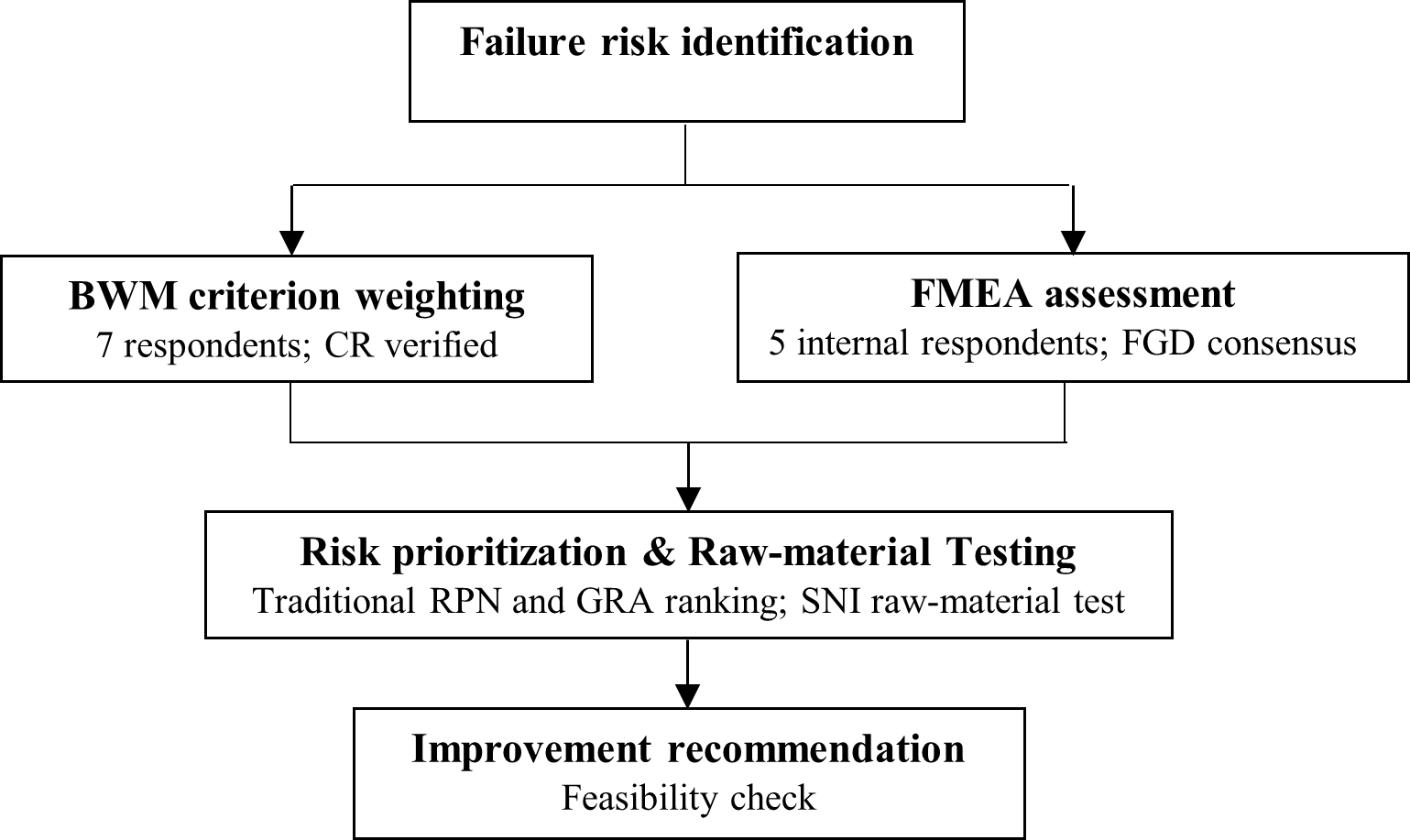
Leather craft MSMEs have substantial economic potential but often struggle to maintain consistent product quality because production relies on manual craft, artisan experience, and limited formal process controls. At the leather craft MSME specializing in leather bags examined in this study, product defects and customer complaints led to rework, material waste, and potential reputational loss. This study develops a case-based quality failure risk prioritization framework that integrates the Best-Worst Method (BWM), Failure Mode and Effects Analysis (FMEA), and Grey Relational Analysis (GRA). Although FMEA, BWM, and GRA have each been applied separately in prior quality-risk studies, their integration remains limited in the leather craft MSME context. Failure risks were identified through observation and interviews, weighted by severity, occurrence, and detection using BWM, rated using FMEA, and prioritized using GRA. The analysis identified 35 failure risks across 13 production stages. Detection received the highest criterion weight, followed by severity and occurrence. GRA ranked 12 highest-priority risks across nine stages, led by inappropriate pattern-making and peeled or scratched product components. For the priority failure risk occurring at the raw material stage, moldy leather was further examined in accordance with SNI 06-0335-1989 (Indonesian National Standard for Cow Leather for Bags and Suitcases – Quality Requirements and Test Methods). The test results revealed nonconformity in moisture content, total ash content, and thickness. These findings indicate that the integrated BWM-FMEA-GRA framework provides a systematic basis for prioritizing quality failure risks and formulating targeted, appropriate quality control recommendations that address the resource constraints of leather craft MSMEs.
References
Aleksic, B., Djekic, I., Miocinovic, J., Miloradovic, Z., Memisi, N., & Smigic, N. (2022). The application of Failure Mode Effects Analysis in the long supply chain – A case study of ultra filtrated milk cheese. Food Control, 138, 109057. https://doi.org/10.1016/j.foodcont.2022.109057
Andy P., W., Faharga, R. A., & Chandra, H. (2024). Systematic Risk Analysis of Railway Component Quality: Integration of Failure Mode & Effect Analysis (FMEA) and Fault Tree Analysis (FTA). Spektrum Industri, 22(2), 77–89. https://doi.org/10.12928/si.v22i2.223
Chang, C. H. (2021). Risk assessment of the operations of maritime autonomous surface ships. Reliability Engineering and System Safety, 207. https://doi.org/10.1016/j.ress.2020.107324
DIY, B. (2025). Berita Resmi Statistik: Perkembangan Ekspor dan Impor Daerah Istimewa Yogyakarta: Desember 2024.
Duleba, S., Moslem, S., & Esztergár-Kiss, D. (2021). Estimating commuting modal split by using the Best-Worst Method. European Transport Research Review, 13(1), 29. https://doi.org/10.1186/s12544-021-00489-z
Ervural, B., & Ayaz, H. I. (2023). A fully data-driven FMEA framework for risk assessment on manufacturing processes using a hybrid approach. Engineering Failure Analysis, 152, 107525. https://doi.org/10.1016/j.engfailanal.2023.107525
Filz, M. A. (2021). Data-driven failure mode and effect analysis (FMEA) to enhance maintenance planning. Computers in Industry, 129. https://doi.org/10.1016/j.compind.2021.103451
Fithri, P., Rafi, M., Pawenary, & Prabuwono, A. S. (2021). Risk analysis of production process for food SMEs using FMEA method: a case study. E3S Web of Conferences, 331, 02010. https://doi.org/10.1051/e3sconf/202133102010
Gambicorti, A. (2026). Meanings and values of the craft market: An integrated perspective through service-dominant logic. International Journal of Management Reviews, 28(1). https://doi.org/10.1111/ijmr.12402
Ghoushchi, S. J. (2023). Road safety assessment and risks prioritization using an integrated SWARA and MARCOS approach under spherical fuzzy environment. Neural Computing and Applications, 35(6), 4549–4567. https://doi.org/10.1007/s00521-022-07929-4
Govindbhai, R. B., & Tathod, P. (2024). Identifying and Mitigating Chemical Hazards Through Hazard Identification and Risk Assessment Using Failure Mode and Effects Analysis (FMEA). Journal of Industrial Safety.
Hosseini, J., Shakeryari, M., Nazari Nejad, A., Mastalizadeh, H., Maleki, M., Wang, J., Rustum, R., Rahmati, M., Doostvandi, F., & Mostafavi, M. A. (2024). Comparison of the Analytic Network Process and the Best–Worst Method in Ranking Urban Resilience and Regeneration Prioritization by Applying Geographic Information Systems. Land, 13(7), 1008. https://doi.org/10.3390/land13071008
Ilbahar, E. (2022). Risk assessment of renewable energy investments: A modified failure mode and effect analysis based on prospect theory and intuitionistic fuzzy AHP. Energy, 239. https://doi.org/10.1016/j.energy.2021.121907
Javed, S. A., Gunasekaran, A., & Mahmoudi, A. (2022). DGRA: Multi-sourcing and supplier classification through Dynamic Grey Relational Analysis method. Computers & Industrial Engineering, 173, 108674. https://doi.org/10.1016/j.cie.2022.108674
Katongole, C. (2026). Practices and challenges of cultural handicraft producers and sellers in the tourism industry in Africa. Tourism and Hospitality Research, 26(4), 830–854. https://doi.org/10.1177/14673584241312858
Kroezen, J., Ravasi, D., Sasaki, I., Zebrowska, M., & Suddaby, R. (2021). Configurations of Craft: Alternative Models for Organizing Work. Academy of Management Annals, 15(2), 502–536. https://doi.org/10.5465/annals.2019.0145
Liou, J. J. H., Liu, P. C. Y., Luo, S.-S., Lo, H.-W., & Wu, Y.-Z. (2022). A hybrid model integrating FMEA and HFACS to assess the risk of inter-city bus accidents. Complex & Intelligent Systems, 8(3), 2451–2470. https://doi.org/10.1007/s40747-022-00657-1
Liu, H.-C., Liu, L., & Liu, N. (2013). Risk evaluation approaches in failure mode and effects analysis: A literature review. Expert Systems with Applications, 40(2), 828–838. https://doi.org/10.1016/j.eswa.2012.08.010
Ma, W., Li, X., & Wang, X. (2021). Water Saving Management Contract, identification and ranking of risks based on life cycle and best-worst method. Journal of Cleaner Production, 306, 127153. https://doi.org/10.1016/j.jclepro.2021.127153
Minguito, G., & Banluta, J. (2023). Risk management in humanitarian supply chain based on FMEA and grey relational analysis. Socio-Economic Planning Sciences, 87, 101551. https://doi.org/10.1016/j.seps.2023.101551
Moktadir, M. A., Dwivedi, A., Khan, N. S., Paul, S. K., Khan, S. A., Ahmed, S., & Sultana, R. (2021). Analysis of risk factors in sustainable supply chain management in an emerging economy of leather industry. Journal of Cleaner Production, 283, 124641. https://doi.org/10.1016/j.jclepro.2020.124641
Padwekar, K., Awasthi, K., Shamim, K., & Misra, S. C. (2026). Metaverse Integration in Agri-Food Supply Chain: Navigating Risks for Food Security and Sustainability. Journal of International Food & Agribusiness Marketing, 1–31. https://doi.org/10.1080/08974438.2026.2616272
Peykani, P., Emrouznejad, A., & Nouri, M. (2026). Best-worst multi-criteria decision-making method: A review of the literature. Socio-Economic Planning Sciences, 104, 102345. https://doi.org/10.1016/j.seps.2025.102345
Rahmatin, N., Santoso, I., Indriani, C., Rahayu, S., & Widyaningtyas, S. (2018). Integration of the Fuzzy Failure Mode and Effect Analysis (Fuzzy FMEA) and the Analytical Network Process (ANP) in Marketing Risk Analysis and Mitigation. International Journal of Technology, 9(4), 809. https://doi.org/10.14716/ijtech.v9i4.2197
Rezaei, J. (2015). Best-worst multi-criteria decision-making method. Omega, 53, 49–57. https://doi.org/10.1016/j.omega.2014.11.009
Rezaei, J. (2016). Best-worst multi-criteria decision-making method: Some properties and a linear model. Omega, 64, 126–130. https://doi.org/10.1016/j.omega.2015.12.001
Shafiee, M. (2021). Unmanned aerial drones for inspection of offshore wind turbines: A mission-critical failure analysis. Robotics, 10(1), 1–27. https://doi.org/10.3390/robotics10010026
Sriwardany, S., Fadhilah, D. D., & & Sunny, R. (2025). Risk Management In Rice Farming Using Hybrid Fmea-Ahp: A Case Study From Hamparan Perak, Indonesia. Acta Innovations, 55(1). https://doi.org/10.62441/actainnovations.v55i.402
Susanto, D. A., Suef, M., Karningsih, P. D., & Prasetya, B. (2025). Safety Design Framework for Short Shelf-Life Food Products in SMEs Using HACCP and FMEA Methods. Operations and Supply Chain Management: An International Journal, 100–112. https://doi.org/10.31387/oscm0600458
Sutanto, A., Putri, N. T., Alqifti, T., & Yusof, S. M. (2025). A Solution Approach on Reducing Defects in Batik Tanah Liek Production Process of a Small and Medium-sized Enterprise. Jurnal Optimasi Sistem Industri, 23(2), 266–282. https://doi.org/10.25077/josi.v23.n2.p266-282.2024
Usgaonkar, G. G. S., & Gaonkar, R. S. P. (2025). GRA and CoCoSo Based Analysis for Optimal Performance Decisions in Sustainable Grinding Operation. International Journal of Mathematical, Engineering and Management Sciences, 10(1), 1–21. https://doi.org/10.33889/IJMEMS.2025.10.1.001
Vierci-Codas, S., Insfran-Rivarola, A., Arevalos, A. P., Macias-Velasquez, S., Zepeda-Lugo, C., & Martínez-Mendoza, E. (2025). Improved performance in retail distribution process through a Lean Manufacturing approach: A case study. Journal of Industrial Engineering and Management, 18(2), 342. https://doi.org/10.3926/jiem.8178
Von, A. A., Petruschke, L., & Frick, N. (2022). Sustainability Failure Mode and Effects Analysis – A systematic literature review. Journal of Cleaner Production, 363, 132413. https://doi.org/10.1016/j.jclepro.2022.132413
Weeden, M. M. (2015). Failure mode and effects analysis (FMEA) for small business owners and non-engineers: Determining and preventing what can go wrong. Quality Press.
Downloads
Published
Issue
Section
License
Copyright (c) 2026 Umi Reza Lestari, Nafis Khuriyati, Anggoro Cahyo Sukartiko

This work is licensed under a Creative Commons Attribution-ShareAlike 4.0 International License.