A Trend-Driven Framework for Integrated SKU-to-Pod Assignment and Replenishment Policy in Robotic Mobile Fulfillment Systems (RMFS)
DOI:
https://doi.org/10.12928/si.v24i2.722Keywords:
Agent based modelling, Robotic mobile fulfillment system, Replenishment policy, SKU-to-pod assignmentAbstract
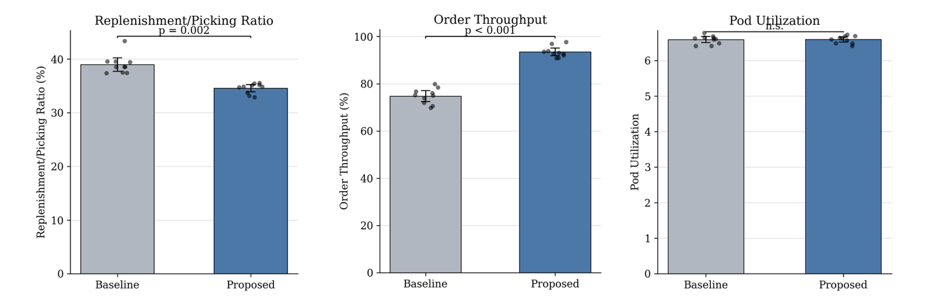
Robotic Mobile Fulfillment System (RMFS) performance is greatly affected by stock-keeping unit (SKU) assignment and replenishment decisions, especially with the changing e-commerce demand. However, current studies typically treat these decisions in isolation, without paying adequate attention to changing demand patterns. The aim of this study is to develop and evaluate a trend-driven framework that combines demand-based SKU clustering, SKU-to-pod assignment and dynamic replenishment strategies for improving the operational performance of RMFS. The proposed framework uses machine-learning based clustering to group SKUs according to their demand characteristics, and then implements capacity-constrained pod assignment and replenishment policies for each cluster. An agent-based simulation was conducted with ten replications to test the proposed strategy against a static baseline, employing order throughput, replenishment-to-picking ratio, and pod utilization as performance indicators. The results show that the proposed framework significantly increases the order throughput from 74.75% to 93.44% (an increase of 18.69 percentage points) and significantly decreases the replenishment-to-picking ratio from 38.98% to 34.56% (a decrease of 4.42 percentage points). Pod utilization remains unchanged, meanwhile. These results suggest that the combination of demand-driven assignment and adaptive replenishment can improve fulfillment efficiency while maintaining pod utilization. This paper proposes an integrated simulation-based decision-support framework for demand clustering, pod assignment and replenishment decisions to enable adaptive RMFS operations under volatile e-commerce demand.
References
Abolghasem, M., Sadeghi, K., Ghazaie, S. H., & Peng. W. (2025). Enhancing nuclear cogeneration efficiency using the low-grade waste heat recovery from nuclear hydrogen production system. Nuclear Engineering and Design. https://doi.org/10.1016/j.nucengdes.2025.114166
Azadeh, K., De Koster, R., & Roy, D. (2019). Robotized and Automated Warehouse Systems: Review and Recent Developments. Transportation Science, 53(4), 917–945. https://doi.org/10.1287/trsc.2018.0873
Benavides-Robles, M. T., Valencia-Rivera, G. H., Cruz-Duarte, J. M., Amaya, I., & Ortiz-Bayliss, J. C. (2024). Robotic Mobile Fulfillment System: A Systematic Review. IEEE Access, 12, 16767–16782. https://doi.org/10.1109/ACCESS.2024.3359434
Boysen, N., de Koster, R., & Weidinger, F. (2019). Warehousing in the e-commerce era: A survey. European Journal of Operational Research, 277(2), 396–411. https://doi.org/10.1016/j.ejor.2018.08.023
Chou, S.-Y., Hendrawan, E., Dewabharata, A., & Zulvia, F. E. (2023). Replenishment Policy and SKU Classification to Pod Assignment Design for Robotic Mobile Fulfillment System Performances. https://doi.org/10.3233/ATDE230633
Cochran, W. G., & Cochran, W. G. (1977). Sampling techniques. academia.edu. https://www.academia.edu/download/53436713/Cochran_1977_Sampling_Techniques__Third_Edition.pdf
Filipovic, M., & Rogic, K. (2025). Robotic Mobile Fulfilment System: A Literature Review. Transportation Research Procedia, 91, 465–472. https://doi.org/10.1016/j.trpro.2025.10.060
Guven, D., Kayalica, M. O., & Bozdag, C. E. (2026). Assessing policy interventions for electric vehicle adoption through an agent-based environmental framework. Applied Energy. https://doi.org/10.1016/j.apenergy.2025.127338
Jain, N., Vamshidhar, M., Kulshrestha, S., & Gupta, N. (2024). Integrating information science into financial management: A comprehensive review of emerging trends and practices. In Library Progress International. https://doi.org/10.48165/bapas.2024.44.2.1
Kalkha, H., Khiat, A., Bahnasse, A., & Ouajji, H. (2024). Enhancing Warehouse Efficiency With Time Series Clustering: A Hybrid Storage Location Assignment Strategy. IEEE Access, 12, 52110–52126. https://doi.org/10.1109/ACCESS.2024.3386887
Keung, K. L., Lee, C. K. M., & Ji, P. (2021). Data-driven order correlation pattern and storage location assignment in robotic mobile fulfillment and process automation system. Advanced Engineering Informatics, 50, 101369. https://doi.org/10.1016/j.aei.2021.101369
Kiabakht, H., & Sajadieh, M. S. (2026). Integrated approach for operations in robotic mobile fulfillment centers under order uncertainty. Transportation Research Part E: Logistics and Transportation Review, 208, 104683. https://doi.org/10.1016/j.tre.2026.104683
Kim, H.-J., Pais, C., & Shen, Z.-J. M. (2020). Item Assignment Problem in a Robotic Mobile Fulfillment System. IEEE Transactions on Automation Science and Engineering, 17(4), 1854–1867. https://doi.org/10.1109/TASE.2020.2979897
Lamballais, T., Merschformann, M., Roy, D., de Koster, M. B. M., Azadeh, K., & Suhl, L. (2022). Dynamic policies for resource reallocation in a robotic mobile fulfillment system with time-varying demand. European Journal of Operational Research, 300(3), 937–952. https://doi.org/10.1016/j.ejor.2021.09.001
Li, X., Hua, G., Huang, A., Sheu, J.-B., Cheng, T. C. E., & Huang, F. (2020). Storage assignment policy with awareness of energy consumption in the Kiva mobile fulfilment system. Transportation Research Part E: Logistics and Transportation Review, 144, 102158. https://doi.org/10.1016/j.tre.2020.102158
Ma, Z., Wu, G., Ji, B., Wang, L., Luo, Q., & Chen, X. (2023). A Novel Scattered Storage Policy Considering Commodity Classification and Correlation in Robotic Mobile Fulfillment Systems. IEEE Transactions on Automation Science and Engineering, 20(2), 1020–1033. https://doi.org/10.1109/TASE.2022.3178934
Mejía, S., & Aguilar, J. (2024). A demand forecasting system of product categories defined by their time series using a hybrid approach of ensemble learning with feature engineering. Computing, 106(12), 3945–3965. https://doi.org/10.1007/s00607-024-01320-y
Merschformann, M., Lamballais, T., de Koster, M. B. M., & Suhl, L. (2019). Decision rules for robotic mobile fulfillment systems. Operations Research Perspectives, 6, 100128. https://doi.org/10.1016/j.orp.2019.100128
Mirzaei, M., Zaerpour, N., & de Koster, R. B. M. (2022). How to benefit from order data: correlated dispersed storage assignment in robotic warehouses. International Journal of Production Research, 60(2), 549–568. https://doi.org/10.1080/00207543.2021.1971787
Pasupuleti, V., Thuraka, B., Kodete, C. S., & Malisetty, S. (2024). Enhancing Supply Chain Agility and Sustainability through Machine Learning: Optimization Techniques for Logistics and Inventory Management. Logistics, 8(3), 73. https://doi.org/10.3390/logistics8030073
Pratiwi, D. T., Chou, S.-Y., Suparno, & Kurniati, N. (2025). Combination of SKU in POD Assignment in Robotic Mobile Fulfillment Systems (pp. 185–195). https://doi.org/10.1007/978-981-97-6492-1_15
Rampone, F., Lecca, F., Giolito, P., & Romano, M. (2023). Blockchain in the agrifood sector: From storytelling to traceability fact-checking up to new economic models. Economia Agro-Alimentare, 25(2), 97–114. https://doi.org/10.3280/ecag2023oa14958
Rizqi, Z. U., Chou, S.-Y., & Oscar, A. D. (2025). Towards energy-efficient Robotic Mobile Fulfillment System: Hybrid agent-based simulation with DEA-based surrogate machine learning. Applied Soft Computing, 176, 113141. https://doi.org/10.1016/j.asoc.2025.113141
Silva, A., Coelho, L. C., Darvish, M., & Renaud, J. (2020). Integrating storage location and order picking problems in warehouse planning. Transportation Research Part E: Logistics and Transportation Review, 140, 102003. https://doi.org/10.1016/j.tre.2020.102003
Sulthana, A. N., & Vasantha, S. (2019). Influence of electronic word of mouth eWOM on purchase intention. In International Journal of Scientific.
Teck, S., Pham, T. S., Rousseau, L.-M., & Vansteenwegen, P. (2025). Deep reinforcement learning for the real-time inventory rack storage assignment and replenishment problem. European Journal of Operational Research, 327(2), 606–622. https://doi.org/10.1016/j.ejor.2025.05.008
Tian, M., Zhang, Q., Tian, D., Jin, L., Li, J., & Xiao, F. (2024). Pre-stability control for in-wheel-motor-driven electric vehicles with dynamic state prediction. IEEE Transactions on Intelligent Vehicles. https://doi.org/10.1109/TIV.2024.3368207
Tsao, Y.-C., Tai, J.-Y., Vu, T.-L., & Chen, T.-H. (2024). Multiple bin-size bin packing problem considering incompatible product categories. Expert Systems with Applications, 247, 123340. https://doi.org/10.1016/j.eswa.2024.123340
Utama, D. M., & Salsabilah, A. L. (2025). Optimizing Green Vehicle Routing Problem for Halal and Non-Halal Products using Salp Swarm Algorithm. Spektrum Industri. https://doi.org/10.12928/si.v23i2.413
van Kampen, T. J., Akkerman, R., & Pieter van Donk, D. (2012). SKU classification: a literature review and conceptual framework. International Journal of Operations & Production Management, 32(7), 850–876. https://doi.org/10.1108/01443571211250112
Wang, M., Liu, X., Wang, L., Bian, Y., Fan, K., & Zhang, R.-Q. (2025). A data-driven optimization model for the scattered storage assignment with replenishment. Computers & Industrial Engineering, 200, 110766. https://doi.org/10.1016/j.cie.2024.110766
Yuan, R., Li, J., Wang, W., Dou, J., & Pan, L. (2021). Storage Assignment Optimization in Robotic Mobile Fulfillment Systems. Complexity, 2021(1). https://doi.org/10.1155/2021/4679739
Zhuang, Y., Zhou, Y., Hassini, E., Yuan, Y., & Hu, X. (2024). Improving order picking efficiency through storage assignment optimization in robotic mobile fulfillment systems. European Journal of Operational Research, 316(2), 718–732. https://doi.org/10.1016/j.ejor.2024.02.025
Downloads
Published
Issue
Section
License
Copyright (c) 2026 Salsabila Herwening Mileniadewi, Shuo-Yan Chou, Sinta Rahmawidya Sulistyo, Anna Maria Sri

This work is licensed under a Creative Commons Attribution-ShareAlike 4.0 International License.