Mapping the End-of-Life Electric Motorcycle Battery System in Indonesia: A Multi-Actor Causal Loop Diagram of OEM, Informal, User, and Government Interactions
DOI:
https://doi.org/10.12928/si.v24i2.741Keywords:
Electric motorcycle, Battery waste management, Causal loop diagram, End-of-life battery, Circular supply chainAbstract
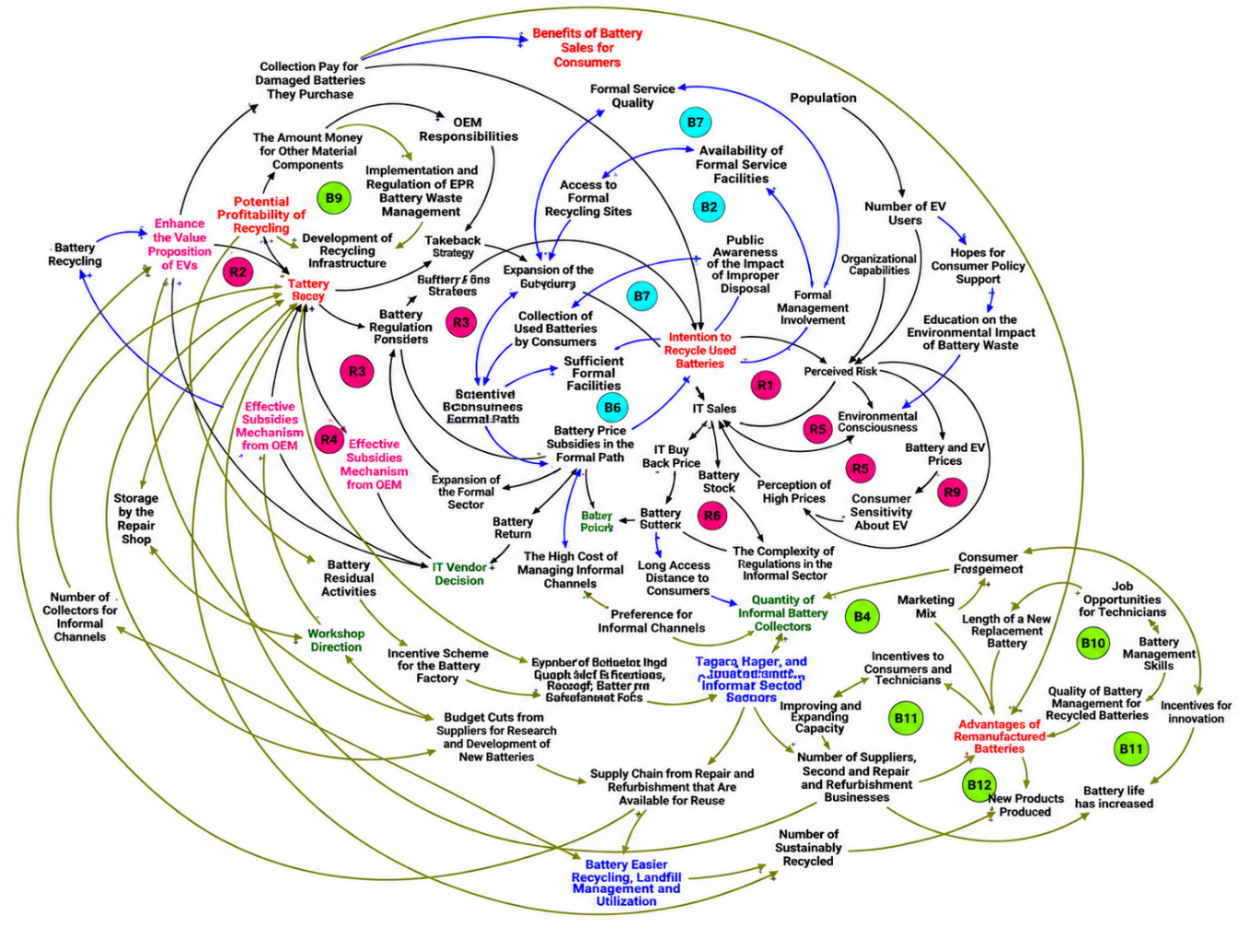
Indonesia’s rapid electric-motorcycle adoption requires circular end-of-life (EoL) battery management to retain material value and reduce environmental risk. In Yogyakarta, unclear return and processing arrangements risk diverting used batteries into informal channels that are economically attractive but often unsafe and poorly traceable. This study develops a stakeholder-informed Causal Loop Diagram (CLD) to map circular pathways for EoL batteries across OEMs, informal workshops, users, and government, and to support a circular battery supply-chain framework. The model integrates market growth, information, service access, incentives, OEM take-back responsibility, informal repair and reuse, and regulation within a single systems perspective. Variables were identified through literature and policy review, refined with AI-assisted reference exploration, and validated through a survey of 98 users, interviews with 8 dealer/OEM representatives and 4 informal actors, and a focus group discussion (FGD) that assessed variable relevance, causal relationships, polarity, and overall CLD structure. The final model comprises 67 variables, 14 reinforcing loops, and 5 balancing loops. It shows that reduced-performance batteries may enter repair, refurbishment, reuse, storage, transfer, or final treatment pathways. Reinforcing dynamics arise from market expansion, informal economic benefits, and convenience, whereas formal incentives, regulation, and risk mitigation generate balancing effects that can redirect flows toward higher-value circular pathways. Key leverage points include accessible formal collection, operational OEM take-back with diagnostic and downstream capacity, and trained informal workshops linked to traceable handover. As a structural model, the CLD does not quantify parameters or simulate outcomes, but provides a basis for future system-dynamics modelling of material recovery, environmental risk, and circular value creation in electric-motorcycle battery supply chains.
References
Anugrah, I. R., Alfariz, M. Z., Sapoe, T. C., & Sahrupi, S. (2025). Model pengelolaan sampah rumah tangga di desa pejaten kecamatan kramatwatu. Metode: Jurnal Teknik Industri. http://ejournal.um-sorong.ac.id/index.php/metode/article/view/4156
Aqmarina, S. N., Nurcahyo, R., & Sumaedi, S. (2024). Accelerating Electric Motorcycle Adoption: Comparison Between Users and Non-Users Perspectives In Jakarta, Indonesia. TEM Journal, 1633–1644. https://doi.org/10.18421/TEM132-76
Casals, L. C., Amante García, B., & Canal, C. (2019). Second life batteries lifespan: Rest of useful life and environmental analysis. Journal of Environmental Management, 232, 354–363. https://doi.org/10.1016/j.jenvman.2018.11.046
Chen, Z., Zhou, H., & Jia, S. (2024). Multiple benefits of new-energy vehicle power battery recycling strategies based on the theory of planned behavior and stimulus organism response. Heliyon, 10(17), e37202. https://doi.org/10.1016/j.heliyon.2024.e37202
Dababneh, F., Aldababneh, H. Z., Khawaja, M. K., & Imam, R. (2025). Policies and actions for electric vehicle battery waste processing using an integrated QFD approach: A case study for Jordan. Heliyon, 11(2), e41940. https://doi.org/10.1016/j.heliyon.2025.e41940
Elements, A. (2023). New Survey: Americans are Increasingly Concerned about Electric Vehicle Battery Disposal, Despite Growth of EV Battery Recycling Industry. In Ascend Elements. Retrieved May.
Fallah, N., & Fitzpatrick, C. (2024). Exploring the state of health of electric vehicle batteries at end of use; hierarchical waste flow analysis to determine the recycling and reuse potential. Journal of Remanufacturing, 14(1), 155–168. https://doi.org/10.1007/s13243-024-00137-4
Fan, J., Teng, H., & Wang, Y. (2022). Research on recycling strategies for new energy vehicle waste power batteries based on consumer responsibility awareness. In Sustainability. mdpi.com. https://www.mdpi.com/2071-1050/14/16/10016
Fathoni, F., Kesidou, E., Rifansha, M. M., & Tiftazani, A. (2025). Drivers and barriers of eco-innovation in electric vehicle diffusion: Evidence from Indonesia. Journal of Environmental Management, 389, 126021. https://doi.org/10.1016/j.jenvman.2025.126021
Guo, M., & Huang, W. (2023). Consumer Willingness to Recycle The Wasted Batteries of Electric Vehicles in the Era of Circular Economy. Sustainability, 15(3), 2630. https://doi.org/10.3390/su15032630
Habiburrahman, M., Tri Setyoko, A., Nurcahyo, R., Daulay, H., & Natsuda, K. (2025). Circular economy strategy for waste management companies of electric vehicle batteries in Indonesia. International Journal of Productivity and Performance Management, 74(11), 21–45. https://doi.org/10.1108/IJPPM-01-2024-0015
Islam, M. T., Huda, N., Baumber, A., Hossain, R., & Sahajwalla, V. (2022). Waste battery disposal and recycling behavior: a study on the Australian perspective. Environmental Science and Pollution Research, 29(39), 58980–59001. https://doi.org/10.1007/s11356-022-19681-2
Ji, G., Wang, J., Liang, Z., Jia, K., Ma, J., Zhuang, Z., Zhou, G., & Cheng, H.-M. (2023). Direct regeneration of degraded lithium-ion battery cathodes with a multifunctional organic lithium salt. Nature Communications, 14(1), 584. https://doi.org/10.1038/s41467-023-36197-6
Jiang, R., Wu, C., Feng, W., You, K., Liu, J., Zhou, G., Liu, L., & Cheng, H.-M. (2025). Impact of electric vehicle battery recycling on reducing raw material demand and battery life-cycle carbon emissions in China. Scientific Reports, 15(1), 2267. https://doi.org/10.1038/s41598-025-86250-1
Kala, K., Bolia, N. B., & Sushil. (2022). Analysis of informal waste management using system dynamic modelling. Heliyon, 8(8), e09993. https://doi.org/10.1016/j.heliyon.2022.e09993
Kumar, A., & F. Rizvi, D. F. (2024). Hazardous Effects of Battery Waste and Role of the Battery Waste Management Rule 2022 in Enhancing Energy Efficiency. International Journal of Current Science Research and Review, 07(11). https://doi.org/10.47191/ijcsrr/V7-i11-14
Luo, D. (2021). Research on the influence of consumers’ environmental preference and government policy on EV battery recycling. IOP Conference Series: Earth and Environmental Science, 651(4), 042057. https://doi.org/10.1088/1755-1315/651/4/042057
Luo, J., Yang, Y., & Jiang, Y. (2025). Assessing the antecedents, processes, and consequences of sustainable electric vehicle battery recycling: A systematic literature review. In International Journal of Production Economics. https://doi.org/10.1016/j.ijpe.2025.109551
Mehta, M. (2025). India’s Battery Recycling Infrastructure Gap: A Critical Review for a Circular Economy. International Journal of Innovative Science and Research Technology, 469–476. https://doi.org/10.38124/ijisrt/25aug374
Nauri, M. M. A., Aziz, M. S., Pratama, M., Kamal, U., & Fikri, M. A. H. (2024). Strategi penanganan limbah baterai kendaraan listrik demi masa depan Indonesia yang lebih bersih. In Kultura: Jurnal Ilmu Hukum, Sosial, dan Humaniora, 2(5), 2985-5624. http://jurnal.kolibi.org/index.php/kultura
Nuarta, I. N., & Sukedi, M. (2024). Kebijakan Hukum Pengaturan Penggunaan Kendaraan Listrik Dalam Penguatan Ketahanan Energi Nasional. Jurnal Preferensi Hukum. https://www.ejournal.warmadewa.ac.id/index.php/juprehum/article/view/10413
Nurdiawati, A., & Agrawal, T. K. (2022). Creating a circular EV battery value chain: End-of-life strategies and future perspective. Resources, Conservation and Recycling, 185, 106484. https://doi.org/10.1016/j.resconrec.2022.106484
Purnamasari, D. M. (2023). Analysis Formal and Informal Sector on Lead Acid Battery: A System Dynamics Approach. Journal of Industrial Engineering and Education. https://jiee.bksti.org/index.php/iee/article/view/23
Purwani, A., Ichsanul Fikri Umar Irawan, & Ramadhan, I. (2025). Pemetaan Potensi Pelaku Informal (Bengkel) Sepeda Motor Listrik yang Bersedia Melakukan Daur Ulang Limbah Baterai. Venus: Jurnal Publikasi Rumpun Ilmu Teknik, 3(4), 135–149. https://doi.org/10.61132/venus.v3i4.1045
Qin, N., Gu, S., Li, Y., Nawaz, T., Ansari, M. Z., & Zhang, K. (2022). Factors affecting the growth formation of nanostructures and their impact on electrode materials: A systematic review. Materials Today …. https://www.sciencedirect.com/science/article/pii/S2542529322002425
Rahmi, E., & Anikusuma, L. E. (2026). Analysis of Circular Waste Using a Causal Loop Diagram (CLD): A Case Study of Sukabumi City. Jurnal Penelitian Pendidikan IPA, 12(1), 129–135. https://doi.org/10.29303/jppipa.v12i1.13814
Rammohan, A., Wang, Y., Kannappan S, S., Kumar P, S., Ashok, B., Kotb, H., AboRas, K. M., & Yousef, A. (2024). Service life estimation of electric vehicle lithium-ion battery pack using arrhenius mathematical model. Frontiers in Energy Research, 12. https://doi.org/10.3389/fenrg.2024.1359596
Santos, A. L., Alves, W., & Ferreira, P. (2025). Challenges faced by lithium-ion batteries in effective waste management. In Sustainability. https://doi.org/10.3390/su17072893
Slattery, M., Dunn, J., & Kendall, A. (2024). Charting the electric vehicle battery reuse and recycling network in North America. Waste Management, 174, 76–87. https://doi.org/10.1016/j.wasman.2023.11.018
Wang, D., Xu, Y., Wang, Y., & Chen, Y. (2024). What determines the batteries recycling behavior of e-bike citizens in Guangzhou?: Integrating place identity and environmental concern into the extended norm activation model. Heliyon, 10(9), e30234. https://doi.org/10.1016/j.heliyon.2024.e30234
Wei, L., Wang, C., & Li, Y. (2022). Governance strategies for end-of-life electric vehicle battery recycling in China: A tripartite evolutionary game analysis. Frontiers in Environmental Science, 10. https://doi.org/10.3389/fenvs.2022.1071688
Wesselkämper, J., Hendrickson, T. P., Lux, S., & von Delft, S. (2025). Recycling or Second Use? Supply Potentials and Climate Effects of End-of-Life Electric Vehicle Batteries. Environmental Science & Technology, 59(30), 15751–15765. https://doi.org/10.1021/acs.est.5c01823
Winda, D. D., & Ardi, R. (2023). Reverse Logistics of Electric Vehicle Battery in Indonesia: A Causal Loop Analysis. In Proc. 4th South American, Conference on Industrial Engineering and Operations Management. https://doi.org/10.46254/SA04.20230093
Yuniarti, E., Dewata, I., Heldi, H., Azam, M., & Barlian, E. (2023). Model of Hospital Infectious Waste Control in Padang City Based on Dynamic Systems. Jurnal Kesehatan Masyarakat, 18(4), 595–603. https://doi.org/10.15294/kemas.v18i4.42713
Zhang, Y., & Ayele, E. Y. (2022). Factors affecting small and micro enterprise performance with the mediating effect of government support: Evidence from the Amhara Region Ethiopia. In Sustainability. https://doi.org/10.3390/su14116846
Zuo, C., Yan, X., Chen, Z., Wei, W., Gao, M., Ling, Y., Zhu, F., Liu, B., Zhou, H., Xu, D., & Zhang, M. (2025). Factors influencing residents’ inclination towards engaging in the recycling of electric vehicle batteries. Humanities and Social Sciences Communications, 12(1), 1380. https://doi.org/10.1057/s41599-025-05704-z
Downloads
Published
Issue
Section
License
Copyright (c) 2026 Annie Purwani, Siti Mahsanah Budijati, Aufha Rafhika, Salsabiela Nurul Alisyah, Meisya Putri Wardani

This work is licensed under a Creative Commons Attribution-ShareAlike 4.0 International License.