Manufacturing and Performance Evaluation of Ecoflex-Based Flexible Strain Sensors Reinforced with MWCNTs and Recycled Battery Carbon
DOI:
https://doi.org/10.12928/si.v24i2.742Keywords:
Flexible strain sensor, Ecoflex/MWCNT–RBC, Sensitivity, Linearity, DurabilityAbstract
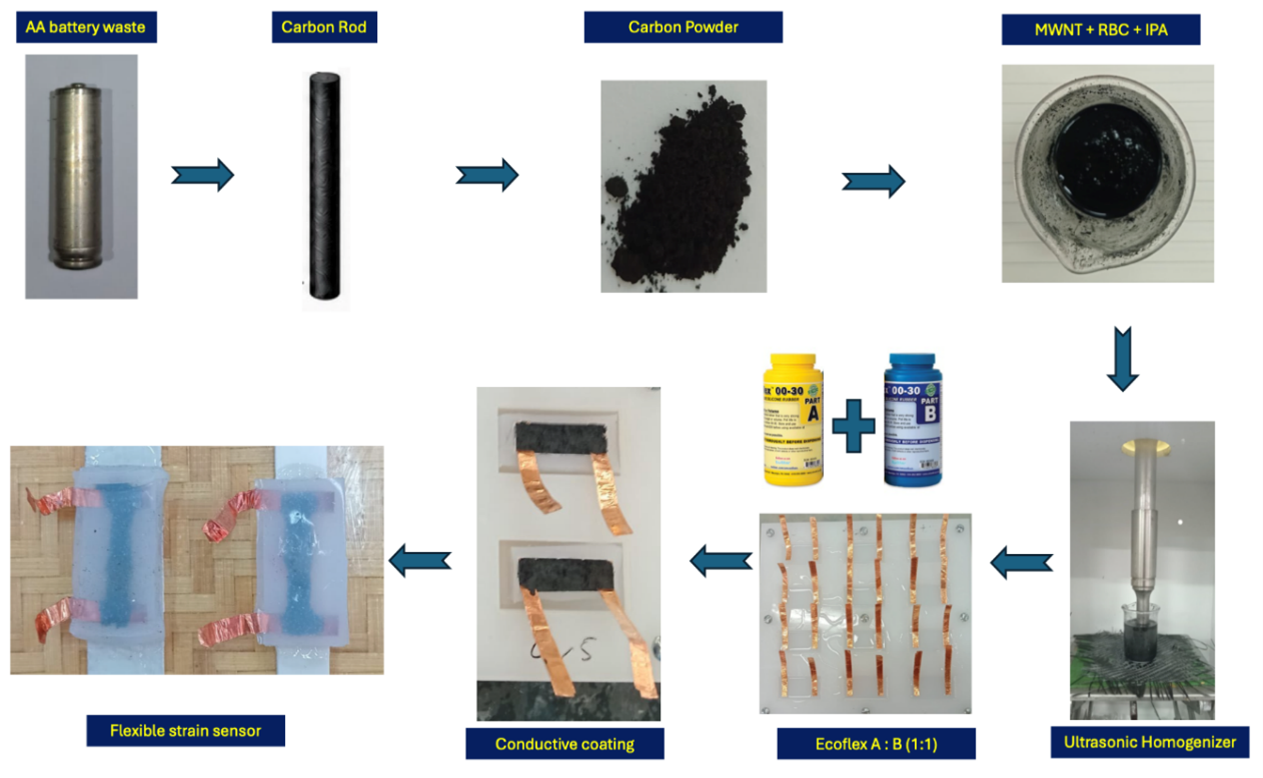
Flexible strain sensors hold great potential for applications in wearable electronic devices, human motion monitoring, and rehabilitation systems. However, the development of such sensors still faces challenges in producing conductive networks that are both sensitive and stable while reducing reliance on commercial conductive materials. This study developed an Ecoflex/MWCNT–RBC-based flexible strain sensor (FSS) by utilizing recycled battery carbon (RBC) obtained from carbon rods in zinc–carbon battery waste. The RBC was separated, washed, dried, crushed, and sieved into a powder, then mixed with multi-walled carbon nanotubes (MWCNT) in isopropyl alcohol using ultrasonic homogenization. The mixture was applied to a pre-cured Ecoflex layer, fitted with copper electrodes, and encapsulated using an Ecoflex layer to produce a layered sensor structure. The morphology and conductive network of the sensor were analyzed using SEM, while its electromechanical performance was evaluated through testing of sensitivity, linearity, cyclic response, response and recovery times, and durability. The sensor produced a measurement factor of 15.42 over a strain range of 0–100%, with a linearity (R²) of 0.994. Response and recovery times were recorded at 70 ms and 70 ms, respectively, while the sensor’s stability was maintained for up to 500 load–unload cycles at 80% strain. These results demonstrate that RBC can serve as a secondary conductive material alongside MWCNT in producing flexible, responsive, and stable strain sensors. This approach offers a sustainable strategy for converting carbon from battery waste into value-added functional materials for wearable sensor applications.
References
Abd H. F. K., Hasan, M. N., Murty, G. E., Ahmad Asri, M. I., Saleh, T., & Mohamed Ali, M. S. (2024). Resistive strain sensors based on carbon black and multi-wall carbon nanotube composites. Sensors and Actuators A: Physical, 366, 114960. https://doi.org/10.1016/j.sna.2023.114960
Abdel, S. K., N., Refay, N. M., Sharaf, Y. A., Ezzat, A., H., & El Nashar, R. M. (2026). Application of poly- methionine/gold nanoparticle-modified recycled battery graphite as an eco-friendly electrochemical sensor for the spasmolytic drug vincamine. RSC Advances, 16(6), 5336–5352. https://doi.org/10.1039/D5RA07233F
Abraham, R., Schneider, J., & vom Brocke, J. (2019). Data governance: A conceptual framework, structured review, and research agenda. International Journal of Information Management, 49, 424–438. https://doi.org/10.1016/j.ijinfomgt.2019.07.008
Alfarros, Z., Hakim, M. L., Utomo, R. S. B., Prawara, B., Kusumawanto, A., & Muflikhun, M. A. (2026). Waste (TSMP) nanocomposite for flexible strain sensors. Sensors and Actuators A: Physical, 400, 117537. https://doi.org/10.1016/j.sna.2026.117537
Bharadwaj, S., Sehrawat, M., Sharma, S., Gupta, T. K., Elizabeth, I., Rani, M., & Singh, B. P. (2025). Strain detection using long-length MWCNT buckypaper-based flexible strain sensor for large strain range. Carbon Trends, 20, 100525. https://doi.org/10.1016/j.cartre.2025.100525
Blakey-Milner, B. (2021). Metal additive manufacturing in aerospace: A review. Materials and Design, 209. https://doi.org/10.1016/j.matdes.2021.110008
Bui, N. K., Nguyen, A.-G., Tran, N. P., Vuong, T. T. T., Dai, N. Do, Nguyen, V. N., Nguyen, P. L., & Ngo, T. (2026). Recycling carbon nanomaterials from spent battery waste for enhanced cementitious composites. Resources, Conservation and Recycling, 230, 108887. https://doi.org/10.1016/j.resconrec.2026.108887
Cetin, M. S., Demirel, A. S., Toprakci, O., & Karahan Toprakci, H. A. (2023). Sustainable, bio-based conductive materials from peanut waste for flexible electronics and tunable piezoresistive strain sensors. Materials Science and Engineering: B, 287, 116140. https://doi.org/10.1016/j.mseb.2022.116140
Chen, X., An, J., Cai, G., Zhang, J., Chen, W., Dong, X., Zhu, L., Tang, B., Wang, J., & Wang, X. (2019). Environmentally Friendly Flexible Strain Sensor from Waste Cotton Fabrics and Natural Rubber Latex. Polymers, 11(3), 404. https://doi.org/10.3390/polym11030404
del Bosque, A., Sánchez-Romate, X. F., Gómez, A., Sánchez, M., & Ureña, A. (2023). Highly stretchable strain sensors based on graphene nanoplatelet-doped ecoflex for biomedical purposes. Sensors and Actuators A: Physical, 353, 114249. https://doi.org/10.1016/j.sna.2023.114249
Fuller, A. (2020). Digital Twin: Enabling Technologies, Challenges and Open Research. IEEE Access, 8, 108952–108971. https://doi.org/10.1109/ACCESS.2020.2998358
Gao, C., Liu, Y., Gu, F., Chen, Z., Su, Z., Du, H., Xu, D., Liu, K., & Xu, W. (2023). Biodegradable Ecoflex encapsulated bacterial cellulose/polypyrrole strain sensor detects motion with high sensitivity, flexibility and scalability. Chemical Engineering Journal, 460, 141769. https://doi.org/10.1016/j.cej.2023.141769
Ge, Y., Ren, G., Yang, J., Shi, X., Chen, H., Fang, Q., & Yang, A. (2026). Flexible carbon blacks/PDMS/Ecoflex strain sensor for motion detection and gesture reconstruction. Materials Letters, 422, 141181. https://doi.org/10.1016/j.matlet.2026.141181
Ghobakhloo, M. (2020). Industry 4.0, digitization, and opportunities for sustainability. In Journal of Cleaner Production (Vol. 252). https://doi.org/10.1016/j.jclepro.2019.119869
Hakim, M. L., Alfarros, Z., Herianto, H., & Muflikhun, M. A. (2025). High sensitivity flexible strain sensor for motion monitoring based on MWCNT@MXene and silicone rubber. Scientific Reports, 15(1), 3741. https://doi.org/10.1038/s41598-025-88372-y
Hakim, M. L., Herianto, & Muflikhun, M. A. (2025). Next-gen strain sensors: Self-healing, ultra-sensitive, lightweight, and durable MWCNT-silicone rubber for advanced human motion tracking. Journal of Engineering Research, 13(4), 3673–3686. https://doi.org/10.1016/j.jer.2024.10.009
Hakim, M. L., Muflikhun, M. A., & Herianto, H. (2025). Investigation of Electro-Mechanical Properties of SR/CNT/SR Flexible Strain Sensor Composites. Solid State Phenomena, 372, 51–56. https://doi.org/10.4028/p-IsM5R3
Htwe, Y. Z. N., Mariatti, M., & Chin, S. Y. (2020). Fabrication of Graphene by Electrochemical Intercalation Method and Performance of Graphene/PVA Composites as Stretchable Strain Sensor. Arabian Journal for Science and Engineering, 45(9), 7677–7689. https://doi.org/10.1007/s13369-020-04807-w
Hu, G., Zhang, Y., Chao, Y., Huang, F., Li, M., Liu, M., & Huang, W. (2025). Tunable sensitivity of strain sensor by coupling piezotronic and tunneling effects. Nano Energy, 145, 111440. https://doi.org/10.1016/j.nanoen.2025.111440
Khan, A., Prathumrat, P., Likitaporn, C., Wongsalam, T., Tanalue, N., Nichakornpong, N., & Okhawilai, M. (2026). AgNP-MWCNT nanocomposites for flexible strain sensors: Comprehensive insights into green synthesis, advanced fabrication technologies, and emerging applications. Synthetic Metals, 316, 118003. https://doi.org/10.1016/j.synthmet.2025.118003
Li, L., Ren, J., Han, L., Zhu, H., Aimaier, X., Fang, L., Hu, H., Zhang, B., & Zhang, R. (2025). Highly sensitive yet strain-insensitive flexible pressure sensors based on MWCNTs/TPU composites for wide-temperature-range applications. Polymer, 339, 129175. https://doi.org/10.1016/j.polymer.2025.129175
Li, W., Cai, X., He, J., Liu, H., Gui, X., & Lin, S. (2026). A flexible strain sensor with high adhesion and mechanical enhancement based on PDMS/MWCNTs. Colloids and Surfaces A: Physicochemical and Engineering Aspects, 737, 139752. https://doi.org/10.1016/j.colsurfa.2026.139752
Ling, J., Shen, J., Lu, S., & Hou, Y. Y. (2026). Vibration-assisted laser-induced graphene for high-performance flexible strain sensors. Sensors and Actuators A: Physical, 410, 118173. https://doi.org/10.1016/j.sna.2026.118173
Long, W., Yao, Y., Ye, Y., Zhang, C., Xu, J., Zhong, D., Fu, Z., Zhang, J., Liu, X., & Xia, L. (2025). Flexible strain sensor based on carbonized corn stalk with three-dimensional network. Industrial Crops and Products, 225, 120496. https://doi.org/10.1016/j.indcrop.2025.120496
Lu, Y., Zhao, X., Tian, Q., Lin, Y., Li, P., Tao, Y., Wang, Z., Ma, J., Xu, H., & Liu, Y. (2024). Hierarchical porous biomass-derived carbon with rich nitrogen doping for high-performance microwave absorption and tensile strain sensing. Carbon, 224, 119083. https://doi.org/10.1016/j.carbon.2024.119083
Rawat, P., P., S. B., Patil, V. J., & P., N. G. (2026). Waste-to-sensor: Repurposing spent Li-ion battery graphite into reduced graphene oxide for electrochemical detection of ascorbic acid. Resources, Conservation and Recycling, 225, 108610. https://doi.org/10.1016/j.resconrec.2025.108610
Roth, K. (2022). Towards Total Recall in Industrial Anomaly Detection. In Proceedings of the IEEE Computer Society Conference on Computer Vision and Pattern Recognition (Vol. 2022, pp. 14298–14308). https://doi.org/10.1109/CVPR52688.2022.01392
Sezer, H. K., & Eren, O. (2019). FDM 3D printing of MWCNT re-inforced ABS nano-composite parts with enhanced mechanical and electrical properties. Journal of Manufacturing Processes, 37, 339–347. https://doi.org/10.1016/j.jmapro.2018.12.004
Simon, P. (2020). Perspectives for electrochemical capacitors and related devices. In Nature Materials (Vol. 19, Issue 11, pp. 1151–1163). https://doi.org/10.1038/s41563-020-0747-z
Wang, C., Xu, W., Wang, Z., Tu, H., Zhu, T., Peng, C., Shi, L., & Wu, L. (2026). Tunneling-to-contact transition enables strain-insensitive pressure sensing beyond the sensitivity–range trade-off. Chemical Engineering Journal, 543, 178410. https://doi.org/10.1016/j.cej.2026.178410
Wang, G., Wang, M., Zheng, M., Yao, S., & Ebo, B. (2022). High-Sensitivity GNPs/PDMS Flexible Strain Sensor with a Microdome Array. ACS Applied Electronic Materials, 4(9), 4576–4587. https://doi.org/10.1021/acsaelm.2c00782
Wang, L., Xiang, D., Zhu, W., Zhao, C., Li, Y., Han, H., Wang, P., & Wang, J. (2020). Flexible piezoresistive strain sensor with high sensitivity based on carbonised waste thermosetting resin. Plastics, Rubber and Composites, 49(7), 300–306. https://doi.org/10.1080/14658011.2020.1747158
Wang, T.-L., Geng, W.-H., Wang, Y.-X., Cheng, Y.-Q., Wang, C.-D., Song, J.-M., Song, J., Zhang, D., Zhu, Q., & Geng, H.-Z. (2026). A highly sensitive carbon nanotube/graphene/PDMS composite flexible film based on multifunctional stretchable strain sensor for human activity monitoring. Journal of Alloys and Compounds, 1079, 189909. https://doi.org/10.1016/j.jallcom.2026.189909
Wang, X., Liu, L., Huang, Y., Gao, Y., Dong, W., & Yao, D. (2026). A GOQD/SWCNT-PDMS flexible strain sensor enabling multi-view KFCM for railway bridge-tunnel monitoring. Measurement, 270, 120803. https://doi.org/10.1016/j.measurement.2026.120803
Wu, G., Bian, P., Wang, X., Yao, M., Li, Z., Tian, J., Wu, H., Yang, J., Gu, H., Ge, Y., Ye, C., Tan, J., Liu, Q., & Wang, C. (2026). Dip-coated stretchable fabric strain sensor using a SEBS/TPU/CNC@carbon black composite. Sensors and Actuators Reports, 11, 100466. https://doi.org/10.1016/j.snr.2026.100466
Wu, Y., Long, X., Li, L., Liu, L., Wu, Y., & Zeng, Z. (2026). Construction of high-mass loading dry-pressed lithium-ion battery electrodes with excellent flexibility via one-dimensional carbon nanomaterials. Journal of Energy Storage, 156, 121668. https://doi.org/10.1016/j.est.2026.121668
Yu, Z., Huang, Y., Li, B., Du, X., Chen, R., Zheng, G., Wang, X., Jiang, J., & Chen, H. (2026). High-performance ZnO/PEO flexible strain sensors for accurate human physiological signal monitoring. Sensors and Actuators A: Physical, 410, 118208. https://doi.org/10.1016/j.sna.2026.118208
Zhang, Z., Weng, L., Guo, K., Guan, L., Wang, X., & Wu, Z. (2022). Durable and highly sensitive flexible sensors for wearable electronic devices with PDMS-MXene/TPU composite films. Ceramics International, 48(4), 4977–4985. https://doi.org/10.1016/j.ceramint.2021.11.035
Downloads
Published
Issue
Section
License
Copyright (c) 2026 Muhammad Luthfi Hakim, Ari Iswanto, Sigit Yatmono, Afri Yudantoko, Mohamad Shaiful Abdul Karim, Didik Hariyanto

This work is licensed under a Creative Commons Attribution-ShareAlike 4.0 International License.